A reader of my book recently asked me why, and how I was going to start a law firm so early on in my legal career. Great question. Here was my answer:
As far as starting my own firm, yes, it's true. Crazy, but true. I am starting it with a law school buddy of mine, who articled in the same city as myself. I became convinced very early on that I did not really like doing work in a subordinate role. I was a very successful business person before law school, and the large drop in pay, responsibility, and autonomy was too much for me to take. I also found early on that my favourite part of the practice of law was client interaction. I was lucky at my firm in that I was given the opportunity to jump into the deep end and fend for myself. As such, it made perfect sense to set up my own shop and enjoy the benefits of higher remuneration, more responsibility and more autonomy. I figured that if the Law Society says that I can do it, then it must be OK. I have known others who have started a solo practice after articling. It's rare. There are two main obstacles, I have found - $ - most people think that they don't have enough money to cover the first 3-6 months. But, I have found that most people who do start a solo practice do so by going and getting a line of credit for $20-30K and away they go. The second obstacle seems to be a timidness about running a business. Admittedly, many law students have zero background in business. I have an advantage in that I have run a number of businesses, or been an executive in a number of businesses.
Further, I am in an area of the world that is booming, there is no shortage or work, and a relative shortage of lawyers.
Lastly, Carpe Diem. Why not?
Post-note: I was extremely lucky to have such supportive mentors in my firm. As well, I have some fantastic friends in law who have promised support when required.
Tuesday, May 16, 2006


Thursday, May 11, 2006
Lawyers: Outrageous contingency fees for lawyers?
In a quirky bit of fate, I read an article on CBC a couple of days after my last post, which dealt with mega-torts and mega-$ for lawyers through contingency fees. Often, lawyers will agree to take on a case based on a contingency arrangement, rather than a flat fee basis. The number has traditionally been 30% of the "winnings" in a case. Lawyers are careful to get into this kind of arrangement, because it can end up being a real gamble, unless the lawyer feels very strongly that they have a potential winning case. Contingency arrangements are common in personal injury law, because the potential payout has traditionally been quite high, thus resulting in a strong fee for the lawyer.
The article that I recently read told of the fees that would be paid out to lawyers for a recently settled case involving compensation for victims of residential schools in Canada - where many aboriginal children and youth were mistreated, abused and often neglected. The fees to the lawyers will amount to about $80 million. That's right $80,000,000.00. That's a lot of zeros! One firm from Saskatchewan, The Merchant Law Group, will receive about 1/2 of that. $40,000,000.00. One firm. They have 50 lawyers. That's $800,000.00 on average per lawyer. No doubt, the junior lawyers will see very little, if any of that money, and the partners will enjoy much higher yearly bonuses this year. The firm put forward that many of their lawyers had gone without pay for extended periods, and that they had invested over $2 Million of their own monies into the class action case. They represented about 9000 clients in the class action.
Hey, I'm all about making a decent living as a lawyer. I wouldn't have gone through the 10 years of education, and a year of articling if there wasn't some promise of a decent yearly take-home at the end of the rainbow. But $40M for one firm. That's outrageous. What makes it more outrageous is that it never even went to court. It was a back-room negotiation. The $40M firm admitted that it wished it had gotten more for its clients. I bet they wished that too.
The deal offers any former student a lump sum of $10,000 each, plus $3,000 for each year spent in the schools. An estimated average of about $30,000.00 for each living former student. It is estimated there are 80,000 people alive today who attended Indian residential schools, according to Statistics Canada. The total payout is about how much a secretary makes in one year. The average age of the former students is 60, but many are sick and living in poverty. This is compensation for many years of actual physical, sexual and mental abuse, plus years of post-abuse mental anguish. Now, consider that a large number of the victims are now dead, and no claim can be made. Do you think that the abuse suffered by residents of the schools has not affected further generations? I do. Here's why. My grandmother attended a residential school. I don't know how badly it sucked, but I do know that it did suck. We can all read victim stories to get an idea of what it was like. My grandmother did not get to be with her family for 10 months of the year for years. She got to go home for summer holidays. During the school year, she wasn't allowed to speak her native languages. That means that Cree was lost for her, for her children, her grandchildren and her great grandchildren. French was also lost, but luckily regained a couple of generations later through self-study.
I ramble on...
Here's the point. For something that affected an entire life, and the lives of the victim's progeny, the government is willing to hand out $30,000.00. Gee...thanks on behalf of all the claimants. For working really hard on the case for a few years, all the while servicing other clients, I would assume, 50 lawyers get to share $40,000,000.00. That's enough for many people to retire on. Retire well. Yeah, they worked hard, I am sure, but they didn't get what the claimants asked for. O the other hand, they chose to take a risk on 9000 clients and to put in a lot of time. But, in my opinion, the risk they took does not reflect 40 million dollar bills.
Am I off here? Am I crazy to think that this situation is really out of whack? Am I going against the grain too much as a member of the Law Society to say that this is bordering on immorality? Let me know.
P.S. How much is $40,000,000.00? It's hard to imagine for me, as I have been in student-related poverty for so long. Here's a funny post about how much $1,000,000.00 is. Here's some more trivia on the subject - how much does $1,000,000.00 weigh?
The article that I recently read told of the fees that would be paid out to lawyers for a recently settled case involving compensation for victims of residential schools in Canada - where many aboriginal children and youth were mistreated, abused and often neglected. The fees to the lawyers will amount to about $80 million. That's right $80,000,000.00. That's a lot of zeros! One firm from Saskatchewan, The Merchant Law Group, will receive about 1/2 of that. $40,000,000.00. One firm. They have 50 lawyers. That's $800,000.00 on average per lawyer. No doubt, the junior lawyers will see very little, if any of that money, and the partners will enjoy much higher yearly bonuses this year. The firm put forward that many of their lawyers had gone without pay for extended periods, and that they had invested over $2 Million of their own monies into the class action case. They represented about 9000 clients in the class action.
Hey, I'm all about making a decent living as a lawyer. I wouldn't have gone through the 10 years of education, and a year of articling if there wasn't some promise of a decent yearly take-home at the end of the rainbow. But $40M for one firm. That's outrageous. What makes it more outrageous is that it never even went to court. It was a back-room negotiation. The $40M firm admitted that it wished it had gotten more for its clients. I bet they wished that too.
The deal offers any former student a lump sum of $10,000 each, plus $3,000 for each year spent in the schools. An estimated average of about $30,000.00 for each living former student. It is estimated there are 80,000 people alive today who attended Indian residential schools, according to Statistics Canada. The total payout is about how much a secretary makes in one year. The average age of the former students is 60, but many are sick and living in poverty. This is compensation for many years of actual physical, sexual and mental abuse, plus years of post-abuse mental anguish. Now, consider that a large number of the victims are now dead, and no claim can be made. Do you think that the abuse suffered by residents of the schools has not affected further generations? I do. Here's why. My grandmother attended a residential school. I don't know how badly it sucked, but I do know that it did suck. We can all read victim stories to get an idea of what it was like. My grandmother did not get to be with her family for 10 months of the year for years. She got to go home for summer holidays. During the school year, she wasn't allowed to speak her native languages. That means that Cree was lost for her, for her children, her grandchildren and her great grandchildren. French was also lost, but luckily regained a couple of generations later through self-study.
I ramble on...
Here's the point. For something that affected an entire life, and the lives of the victim's progeny, the government is willing to hand out $30,000.00. Gee...thanks on behalf of all the claimants. For working really hard on the case for a few years, all the while servicing other clients, I would assume, 50 lawyers get to share $40,000,000.00. That's enough for many people to retire on. Retire well. Yeah, they worked hard, I am sure, but they didn't get what the claimants asked for. O the other hand, they chose to take a risk on 9000 clients and to put in a lot of time. But, in my opinion, the risk they took does not reflect 40 million dollar bills.
Am I off here? Am I crazy to think that this situation is really out of whack? Am I going against the grain too much as a member of the Law Society to say that this is bordering on immorality? Let me know.
P.S. How much is $40,000,000.00? It's hard to imagine for me, as I have been in student-related poverty for so long. Here's a funny post about how much $1,000,000.00 is. Here's some more trivia on the subject - how much does $1,000,000.00 weigh?
Monday, May 08, 2006
Law in Literature: The King of Torts - a short review

I just finished reading John Grisham's King of Torts. It was a very entertaining read and fairly creative. It was equally frustrating - almost maddening - to read. The main character, Clay, gets handed a supposed "lottery winning" opportunity, but he never really suffers any kind of ethical struggle with himself. I began very early on to think that he was a loser, just like his father who had been disbarred some years before. As usual, Grisham attempts to smooth over the ethical issues, and make it more of a struggle about taking risks to make mega-bucks.
I was pretty shocked by the $ figures peppered throughout the book. I had no idea of the extent of mass tort litigation, or the numbers involved. The book was convincing in many instances - i.e. that this kind of back room manipulation through tort litigation could make or ruin corporations. As well, it was pretty fascinating to read about what the life of mega-lawyers might be like. How anyone could possibly justify purchasing a $42M private jet is completely beyond me, and I would rather choose to live my life in a more simplified bubble than contemplate such things. I often have a hard time charging someone the rates that I do to write them a will, or do a real estate transaction. Taking 30% of a multi-million dollar settlement would certainly cause me to pause, I think.
One other thing that really bothered me about this book, as with some of Grisham's other books, is the seemingly easy transition from law school, or in this case, from being a lowly lawyer at the district attorney's office, to mega-law firm or mega-litigation. Again, Grisham glosses over the idea that it might take more than reading over a few rules of court, or asking a couple veteran colleagues what needs to happen to succeed. I think that you would have better odds of winning big on slot machines than of succeeding in the big leagues of law without proper and lengthy preparation (i.e. years) before taking on the big case(s). But, I guess that is what makes good American legal drama - that David vs. Goliath set-up, and in this case, that emulation of the fall of David from a situation that could have been so easy and ultimately satisfying.
Thursday, May 04, 2006
More Professors Ban Laptops in Law Classes
Here's something controversial (at least for law students). Some Penn State law school professors have banned laptops in their classrooms, claiming that students are too distracted as they surf the web, and in some cases, play poker during class. What do you think?
Myself, I found my laptop a very useful tool during law school, as I detested taking notes by hand. However, I also found it very distracting and rude when classmates would be surfing The Gap and SI.com or, worst of all, playing solitaire incessently.
Laptops are supposed to be a resource to help you in class, not a mode of distraction. If you are finding class so boring, go home, read your textbook. You'll get a lot more out of it.
Myself, I found my laptop a very useful tool during law school, as I detested taking notes by hand. However, I also found it very distracting and rude when classmates would be surfing The Gap and SI.com or, worst of all, playing solitaire incessently.
Laptops are supposed to be a resource to help you in class, not a mode of distraction. If you are finding class so boring, go home, read your textbook. You'll get a lot more out of it.
Wednesday, April 26, 2006
Law School: Books for Sale - Great Deal
I have a number of copies of my book (So, You Want to be a Lawyer, Eh?: A Comprehensive Guidebook for Prospective and Current Canadian Law Students) that were slightly damaged in transit. Booksellers will not accept books for their stores unless they are in pristine condition. As such, the books were sent to me. I have no use for a bunch of my own books, so I thought I would offer you all a sweet deal. The books are in almost new condition. They were dropped out of a box, so they may have a little dust or a scratch on the cover. Nothing more.
You can buy the book on Amazon.ca for $17.39 CDN plus shipping. You can get it for $12.99 US plus shipping and duty on Amazon.com.
I will mail you a copy of the book for $9 CDN plus shipping plus $1 handling fee. I think that's a pretty fair price, given that the retail price is $24.99. Give me an email if you are interested, providing your address and I will confirm the shipping cost to you. If you have any further questions about the book, please let me know.

You can buy the book on Amazon.ca for $17.39 CDN plus shipping. You can get it for $12.99 US plus shipping and duty on Amazon.com.
I will mail you a copy of the book for $9 CDN plus shipping plus $1 handling fee. I think that's a pretty fair price, given that the retail price is $24.99. Give me an email if you are interested, providing your address and I will confirm the shipping cost to you. If you have any further questions about the book, please let me know.

Monday, April 24, 2006
Law Articles: Closing in on becoming a lawyer
Time stretches on in these last two months before my bar call. I just finished a judge's rotation at the courthouse, which was fantastic! It was one of the highlights of my article. I got to meet a lot of the judges and justices and see first hand what they do each day. They willingly gave us a ton of information that will help us to be successful in the court system. It was pretty inspiring to get the real information straight from the judge's mouth.
I am keeping very busy finishing up a bunch of files, doing various research for lawyers, and getting ready to open my own law firm. That has been a ton of work so far, and it's tough to fit it in with everything else.
To think that it has been almost 4 months since I embarked upon this career, and a year before that when I began preparing madly. Was it worth it? So far, yes. The next year will really provide the answer to that question. Law school was fantastic. The article was great. Both were harder than hell. Now real practice will provide the true test. Now I will really get to feel what it is like to be a lawyer.
I am keeping very busy finishing up a bunch of files, doing various research for lawyers, and getting ready to open my own law firm. That has been a ton of work so far, and it's tough to fit it in with everything else.
To think that it has been almost 4 months since I embarked upon this career, and a year before that when I began preparing madly. Was it worth it? So far, yes. The next year will really provide the answer to that question. Law school was fantastic. The article was great. Both were harder than hell. Now real practice will provide the true test. Now I will really get to feel what it is like to be a lawyer.
Tuesday, April 11, 2006
Law School News: Law School in the News
University of Toronto Law School has decided to raise its tuition. They are going for the full 8% increase allowed under Ontario's new tuition rules. When will the carnage stop?!?? Ouch.
Wednesday, April 05, 2006
Law School: The progression into law
Everybody has their own story about why they decided to write the LSAT and apply for law school. Everybody has their own story about why they chose the law classes that they chose, why they decided to get involved in the extracurricular activities, the law moots, the summer positions, etc. that they partook of during law school. Everyone has their own story about why they chose to apply or accept an offer at a Big Firm, a medium firm, a small firm or a public practice outfit. Everyone has their own story about why they decided to work in a Big City, a Small City, or even a Town.
So, What’s Your Story? I am interested, and would love to hear how you came to your decisions. Whatever stage of your legal career. I am sure that others would love to hear other’s stories.
Here’s mine, now that I am done law school, and just about to finish articling, in case you care:
I went to law school because the industry that I worked in popped. The “bubble” burst. Our company ran out of money, the economy was tanking, and I wanted to enter a field where there was the promise of more security. There have always been lawyers, always will be lawyers. I chose to take the law classes that really interested me. It has paid off, as I am now practicing in the areas that interest me. I often struggle with some of the core subject areas, such as Debtor/Creditor, Wills, Family, etc., but have found that I have been able to pick up my socks in those areas by “jumping into the deep end” of private practice. I chose to get very involved in law school leadership opportunities, a moot, and the Law Review. I regret spending too much time away from my family, but do not regret the things that I experienced or learned from these law school activities. I chose to apply to non-conventional summer jobs – in house legal department at a multinational corporation, and Editor in Chief of the Law Review. I chose (among a variety of offers in 4 different centres - some at Big Firms) to accept an articling position in a small city, as I felt I would get a more hands-on experience. It paid off! I have been able to go to court on many occasions, my practice is nearly exclusively my own client-base, and I rarely did “research memos” during my article. I am now breaking off and starting my own firm with a partner, with offices in a few centres, and with myself enjoying the life of a “country lawyer” in a nice small town. Life is great when you create your own circumstances.
So again, what’s your story?
So, What’s Your Story? I am interested, and would love to hear how you came to your decisions. Whatever stage of your legal career. I am sure that others would love to hear other’s stories.
Here’s mine, now that I am done law school, and just about to finish articling, in case you care:
I went to law school because the industry that I worked in popped. The “bubble” burst. Our company ran out of money, the economy was tanking, and I wanted to enter a field where there was the promise of more security. There have always been lawyers, always will be lawyers. I chose to take the law classes that really interested me. It has paid off, as I am now practicing in the areas that interest me. I often struggle with some of the core subject areas, such as Debtor/Creditor, Wills, Family, etc., but have found that I have been able to pick up my socks in those areas by “jumping into the deep end” of private practice. I chose to get very involved in law school leadership opportunities, a moot, and the Law Review. I regret spending too much time away from my family, but do not regret the things that I experienced or learned from these law school activities. I chose to apply to non-conventional summer jobs – in house legal department at a multinational corporation, and Editor in Chief of the Law Review. I chose (among a variety of offers in 4 different centres - some at Big Firms) to accept an articling position in a small city, as I felt I would get a more hands-on experience. It paid off! I have been able to go to court on many occasions, my practice is nearly exclusively my own client-base, and I rarely did “research memos” during my article. I am now breaking off and starting my own firm with a partner, with offices in a few centres, and with myself enjoying the life of a “country lawyer” in a nice small town. Life is great when you create your own circumstances.
So again, what’s your story?
Thursday, March 23, 2006
Law School: Queen's Law Life: Correlation between the average law tuition ($6,800) and the average law prof's salary ($136,634)?
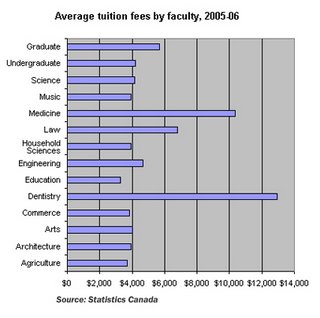
There is an exellent article on Queen's Law Life looking at law tuition compared to law professor salaries. It is insightful commentary on the current state of law tuition. I found it very illuminating.
You may want to do some futher research into law school tuition at your school of choice. Is it comensurate with what you hope to get out of law school? Will it allow you to make the kind of money that you want to make?
One other comment that I would like to add to the matter is that law professors often begin their professorships with an LLM (Master of Laws). They do not require a PhD, although some do achieve this degree. It's true that you require two degrees before becoming an LLM candidate, and that many people consider the LL.B/JD equal to graduate school (i.e. a Masters level), but it is still worth considering that law professors do not require that PhD status. In fact, I had some professors who had been teaching for many years with only an LL.B. degree.
You can also find further discussion here and here (very interesting to me) on the LL.B / JD (Bachelor of Laws vs. Juris Doctorate of Laws) on Queen's Law Life.
Friday, March 17, 2006
Law Eh? Law School in Canada - Second Edition
I have now started work on the 2nd edition of So, You Want to be a Lawyer, Eh? The title will be changed to Law Eh? Law School in Canada. Why? Because of the way in which search engines and online bookstore searches work. Changing the name will make the book more accessible to prospective and current Canadian law students. The new edition will be available in July/August 2006. I will keep you posted.
I am looking for feedback. What would you like included in the 2nd edition? Please leave your comments in the comments section, or give me an email.
Things that I will be adding are:
1. Words of Wisdom from more current and graduated law students from eastern (i.e. Ontario, Maritimes) law schools.
2. More information on alternative legal careers.
3. A section on what it is like to be a lawyer - i.e. why would I want to go into law school?
4. More commentary on the effects of rising tuition for law school.
5. I am also considering including a new law school ranking. However, this may be more useful to you as a separate publication. Let me know what would be better for you.
6. More information on attending law school in other jurisdictions and information on practicing in non-Canadian jurisdictions with a Canadian law degree.
7. An update on the J.D. / LL.B. debate.
8. More expansive commentary on what to expect during your articling year.
9. A new section on passing bar requirements / preparing for bar requirements.
10. New commentary on law school attitudes - how to really achieve success.
11. Updated entrance statistics from each law school in Canada.
12. More reviews of online resources and books about success in law school.
13. A panel of students from across Canada telling you, in their opinion, "what it really takes to succeed in law school".
14. A new section on "if I knew then what I know now" - how to avoid various pitfalls in law school...and beyond.
15. More sample resumes, statements of interest, and cover letters.
16. More detailed information on salary ranges at law firms across the country.
17. Continued commentary on what articling students and first year associates are being paid compared to how much they are working.
18. More information on what the various areas of law are really like - i.e. what do you do as a corporate lawyer, a criminal lawyer, a real estate lawyer, a family lawyer...
19. New information on law school scholarships.
20. How to win the CPLED game (for Western provinces).
If you would like to see the Table of Contents for the current edition, click here. It's packed full of information already, and you might find it useful, especially if you just found out that you are accepted to law school (congrats, by the way!).
We are also thinking about making the book available in Palm and MS Lit formats. Is this something you would be interested in?
Lastly, we are looking for a few graduates to add their Pearls of Wisdom to the book. This is your chance to really let the world know what you would have done differently, what you did to rock the world in law school, etc. Give me an email if you are interested. The book is currently available in print and as an eBook in PDF format.
I am looking for feedback. What would you like included in the 2nd edition? Please leave your comments in the comments section, or give me an email.
Things that I will be adding are:
1. Words of Wisdom from more current and graduated law students from eastern (i.e. Ontario, Maritimes) law schools.
2. More information on alternative legal careers.
3. A section on what it is like to be a lawyer - i.e. why would I want to go into law school?
4. More commentary on the effects of rising tuition for law school.
5. I am also considering including a new law school ranking. However, this may be more useful to you as a separate publication. Let me know what would be better for you.
6. More information on attending law school in other jurisdictions and information on practicing in non-Canadian jurisdictions with a Canadian law degree.
7. An update on the J.D. / LL.B. debate.
8. More expansive commentary on what to expect during your articling year.
9. A new section on passing bar requirements / preparing for bar requirements.
10. New commentary on law school attitudes - how to really achieve success.
11. Updated entrance statistics from each law school in Canada.
12. More reviews of online resources and books about success in law school.
13. A panel of students from across Canada telling you, in their opinion, "what it really takes to succeed in law school".
14. A new section on "if I knew then what I know now" - how to avoid various pitfalls in law school...and beyond.
15. More sample resumes, statements of interest, and cover letters.
16. More detailed information on salary ranges at law firms across the country.
17. Continued commentary on what articling students and first year associates are being paid compared to how much they are working.
18. More information on what the various areas of law are really like - i.e. what do you do as a corporate lawyer, a criminal lawyer, a real estate lawyer, a family lawyer...
19. New information on law school scholarships.
20. How to win the CPLED game (for Western provinces).
If you would like to see the Table of Contents for the current edition, click here. It's packed full of information already, and you might find it useful, especially if you just found out that you are accepted to law school (congrats, by the way!).
We are also thinking about making the book available in Palm and MS Lit formats. Is this something you would be interested in?
Lastly, we are looking for a few graduates to add their Pearls of Wisdom to the book. This is your chance to really let the world know what you would have done differently, what you did to rock the world in law school, etc. Give me an email if you are interested. The book is currently available in print and as an eBook in PDF format.
Wednesday, March 15, 2006
Law School: Canadian Law School Success
A few tidbits for today:
The Princton Review gives some good tips on how to attack law school classes. It's worth a quick read. Tips for Classroom Success.
You can find some more Law School Survival Tips at Reach Canada.
Waterloo gives some good tips on Applying for Law School.
Want to read about what some Windsor LLB grads have done with their lives? Read on.
The Princton Review gives some good tips on how to attack law school classes. It's worth a quick read. Tips for Classroom Success.
You can find some more Law School Survival Tips at Reach Canada.
Waterloo gives some good tips on Applying for Law School.
Want to read about what some Windsor LLB grads have done with their lives? Read on.
Monday, March 13, 2006
Law School: Kawaskimhon National Aboriginal Rights Moot
The Law Times recently posted a short article on the Kawaskimhon National Aboriginal Rights Moot, a moot that I participated in during my second year of law school. It was a fantastic experience! If you are interested in this moot, give me an email and I can give you more information on what it was like, what was required, etc.
Starting a law firm
So, on Friday I was offered a position at my law firm for next year. I will complete my articles on May 31, 2006. I was flattered, and happy to receive an offer. However, I turned it down. Why? Because, I have decided, along with a former classmate, to start my own law firm. We will hang our shingle on July 1, 2005. Think I am nuts?
Happy are those who dream dreams and are ready to pay the price to make them come true.
--Leon J. Suenes
Happy are those who dream dreams and are ready to pay the price to make them come true.
--Leon J. Suenes
Friday, March 10, 2006
Success Stories: Metamorphosis turns law student into actor
I read an interesting article in The Star about a fellow who found out very early on that law school wasn't for him. Instead, it was the stage. It is refreshing to hear about law students who are honest with themselves, and who don't drag themselves through the experience of law school, knowing that it will not lead them to happiness. Too often students force themselves through law school knowing in their heart that they will never love the law. I am not saying that you have to absolutely love the law. But, you certainly should not revile it either, as some of my classmates apparently did. I wonder how many unhappy lawyers would have had amazing careers if they had been more honest with themselves early on during law school. I have an uncle who worked in a rather large law firm for nearly 20 years, apparently hating it! He then finally made a rash decision and went to work somewhere else as an environmental lawyer. His schedule changed as well, and allowed him to explore his true love - acting. There is one truth out of all of this - be true to yourself - at every mile and at every intersection in life. Law school is not for everyone.
Law School: Don't share your law school grades
With the exception of your Mom, Dad, husband or wife and maybe your best friend (that isn’t in law school), do not share your grades with anyone. It does not help anybody, including you. It leads to negative emotions, either on your part, or on the part of your confidant. It leads to unnecessary gossip, unnecessary stress and ultimately does more harm than good most of the time. Assume that everyone else is getting great grades, and work hard to keep up with the rest of the class. Remember, everything is graded on a curve (the most common grade is a B), and that your goal is to stay on the right side of that curve. Also, remember that it is more important to show improvement, dedication and perseverance when it comes to recruiters. True, some recruiters will have a bias towards those who receive top marks. However, do not count yourself out if you have received some low marks in your first year. Recruiters look at a lot more things than grades, contrary to popular opinion.
Wednesday, March 08, 2006
Law School: New CANS, Outlines, Summaries for Law School
Cecilia Perdigao / Jenny Hopkins kindly sent me some first year law school outlines / summaries today. I will post them at http://www.canadianlawschool.ca. Constitutional Law and Contracts Law. Enjoy! There will soon be a number of CANS from my law school experience there as well, along with links to outlines from other Canadian law schools.
Thursday, March 02, 2006
Law School Admissions: Mastering the LSAT - How to Score 160 or More
It's been some time since I gave a lot of thought to the LSAT (Law School Admission Test). More than four years, in fact. I came across a thread at lawstudents.ca, which I thought was quite ingeneous and useful.
The original post said:
I'm writing to inquire of the methods/techniques ppl who scored 160+ [on the LSAT] used to get the score they did.
1) What score did you get?
2) What books did you use? (Kaplan, Powerscore LRB, Powerscore LGB, etc)
3) What prep courses did you take (if any)? Full length, weekend?
4) How long did you study for, and under what conditions? (during school, during the summer, etc)
5) How many preptests did you do?
6) What would you change if you were to do it again?
7) Any other misc comments/suggestions.
8 ) What undergrad degree did you do? (or are doing)
I was intrigued to read the answers given by a variety of posters. You may find this information very useful if you hope to score well on the LSAT. There's even one fellow who scored 171 (98th percentile). I get the feeling that most of these posters took the LSAT very seriously!
I myself did 2 or 3 practice exams, used some prep book that I got out of a bargain bin at Chapters, which included a CD-ROM with lots of practice questions on it. I had a real adventure the first time around (read my book to find out the story), and managed to do quite well the second time around, once I got my bearings and my attitude right.
The LSAT is not a small-potatoes test for most people. There are those out there who can ace it without ever studying, but most of us mere mortals probably need at least some preparation to help guide us. The one sense I have gotten over the years is that prep courses are often a waste of time. You need to find your own tricks, and just practice, practice practice.
The original post said:
I'm writing to inquire of the methods/techniques ppl who scored 160+ [on the LSAT] used to get the score they did.
1) What score did you get?
2) What books did you use? (Kaplan, Powerscore LRB, Powerscore LGB, etc)
3) What prep courses did you take (if any)? Full length, weekend?
4) How long did you study for, and under what conditions? (during school, during the summer, etc)
5) How many preptests did you do?
6) What would you change if you were to do it again?
7) Any other misc comments/suggestions.
8 ) What undergrad degree did you do? (or are doing)
I was intrigued to read the answers given by a variety of posters. You may find this information very useful if you hope to score well on the LSAT. There's even one fellow who scored 171 (98th percentile). I get the feeling that most of these posters took the LSAT very seriously!
I myself did 2 or 3 practice exams, used some prep book that I got out of a bargain bin at Chapters, which included a CD-ROM with lots of practice questions on it. I had a real adventure the first time around (read my book to find out the story), and managed to do quite well the second time around, once I got my bearings and my attitude right.
The LSAT is not a small-potatoes test for most people. There are those out there who can ace it without ever studying, but most of us mere mortals probably need at least some preparation to help guide us. The one sense I have gotten over the years is that prep courses are often a waste of time. You need to find your own tricks, and just practice, practice practice.
Tuesday, February 28, 2006
Law School: Do your own CAN or Outline
Even if you find the very best CAN (Condensed Annotated Notes, also known as an outline) in the world for a particular course, you will want to create your very own, from scratch; CAN before you hit the exam room. You may think that you can get away without this step (and there may be a few of you out there who can do this), but for most of us, this is a necessary step in the learning, synthesizing and memorizing process. By physically writing your own review notes, you will most likely be able to recall information more quickly and efficiently. This is especially true for closed-book exams. For open-book exams, writing your own CAN will allow you to be more familiar with the information, and you will be able to flip more quickly through your notes during the exam.
I always found writing a CAN from scratch after studying my class notes and other materials to be an invaluable exercise to help me see where I am. I started with a fresh piece of paper or computer screen, and simply wrote out as much of the course as I wasable to in as little space as possible. I included all relevant cases, statutes, and supplementary information as possible, all the while trying to make as many links in the information as possible. I tried to remember why a particular case or statute was important in the big picture, whether it had altered or developed the law, and what the potential problems or solutions might be as a result of the reasoning of the case or statute. I may have included some personal comments about where I thought this case or statute may come up in an exam question, or would write myself little notes that would help me to readily recall a piece of information come exam time. Whatever helped, I included it. I tried to keep it as concise as possible, while trying not to omit potentially important information. This is a tough balance to strike, and it may take you a few times to get it figured out. The important thing is to avoid relying upon other people’s work in hopes that it will get you by. The truth of the matter is that it usually will only just get you by, or slightly less. To succeed, there is no better alternative than putting in that effort and making it happen for yourself.
A Word from the Wise – Practical Experience from some colleages of mine:
Unless you have a very bad and disorganized professor and you have to teach yourself the course, other people’s CANs are not the best or most efficient way to learn a course because it is actually the creation of the CAN that helps you learn the material much more than simply studying someone else’s. That said, it is better to read a commercial CAN or someone else’s CAN than nothing at all.
— Robin Penker, University of Alberta
To prepare for law school exams I would go through my notes and create my own “CAN”. Once that was finished, I would compare that to the commercial CAN and look for discrepancies. The next step was to create a list of cases from the course with a one-line explanation of the ratio. When I started, I would spend less time organizing and more time trying to study by reading the notes repeatedly. As school progressed, I found it more effective to spend much more time organizing notes and continuously revising them as I studied.
— Jaime Johnson, University of Alberta
What is your favourite way to prepare for an exam? (I know some of you like to keep it a secret, but remember, sharing always results in rewards later on - I speak from experience).
If you want some CANs/Outlines to help you get started, go to http://www.canadalawstudent.ca/cans.html where you will find links to CANs from different law schools, and all of my CANs from law school. Happy downloading!
I always found writing a CAN from scratch after studying my class notes and other materials to be an invaluable exercise to help me see where I am. I started with a fresh piece of paper or computer screen, and simply wrote out as much of the course as I wasable to in as little space as possible. I included all relevant cases, statutes, and supplementary information as possible, all the while trying to make as many links in the information as possible. I tried to remember why a particular case or statute was important in the big picture, whether it had altered or developed the law, and what the potential problems or solutions might be as a result of the reasoning of the case or statute. I may have included some personal comments about where I thought this case or statute may come up in an exam question, or would write myself little notes that would help me to readily recall a piece of information come exam time. Whatever helped, I included it. I tried to keep it as concise as possible, while trying not to omit potentially important information. This is a tough balance to strike, and it may take you a few times to get it figured out. The important thing is to avoid relying upon other people’s work in hopes that it will get you by. The truth of the matter is that it usually will only just get you by, or slightly less. To succeed, there is no better alternative than putting in that effort and making it happen for yourself.
A Word from the Wise – Practical Experience from some colleages of mine:
Unless you have a very bad and disorganized professor and you have to teach yourself the course, other people’s CANs are not the best or most efficient way to learn a course because it is actually the creation of the CAN that helps you learn the material much more than simply studying someone else’s. That said, it is better to read a commercial CAN or someone else’s CAN than nothing at all.
— Robin Penker, University of Alberta
To prepare for law school exams I would go through my notes and create my own “CAN”. Once that was finished, I would compare that to the commercial CAN and look for discrepancies. The next step was to create a list of cases from the course with a one-line explanation of the ratio. When I started, I would spend less time organizing and more time trying to study by reading the notes repeatedly. As school progressed, I found it more effective to spend much more time organizing notes and continuously revising them as I studied.
— Jaime Johnson, University of Alberta
What is your favourite way to prepare for an exam? (I know some of you like to keep it a secret, but remember, sharing always results in rewards later on - I speak from experience).
If you want some CANs/Outlines to help you get started, go to http://www.canadalawstudent.ca/cans.html where you will find links to CANs from different law schools, and all of my CANs from law school. Happy downloading!
Friday, February 24, 2006
Law School Admissions: Deferring law school in Canada
Many prospective law students do not realize that there is often an opportunity to defer your studies for up to one year. Note that not all law schools offer this option. However, it may be a good option for you. Some examples of good reasons to defer law studies for a year are:
1. Finishing a graduate degree. I know of one classmate who attempted to finish a Master of Arts degree concurrently, without joint-degree status, and ended up spending both summers tackling the issue. Had he taken a year off before studying law, he might have circumvented the high stress he experienced. He also would have opened up his summers to potentially work in the legal field. Another student attempted the same with a Master of Science and ended up spending her first summer doing something that she did not feel would help directly with her law career. However, both of these individuals had made a commitment to finish their graduate degrees.
2. Getting an offer for a job that you just cannot refuse. I had a friend who received an offer to work for the Liberal Party in Ottawa – something he had always wanted to do. He managed to get a deferral from some of the schools that he had applied to and was able to try the government job. It was a great résumé booster, and a fantastic opportunity that he would have missed otherwise.
3. You need to save up for school. Now you can take up to a year to work full time, get prepared, and the pressure will be off, because you have already been accepted.
Be sure that you apply for deferral in plenty of time, and that you put forward a very strong case. Do not just assume that a school will hold a spot for you once you have received an offer. Also check into tuition fee hikes or differential fees that your faculty may have scheduled. If waiting an extra year will add thousands of dollars to your cost, you should consider this in your decision-making.
1. Finishing a graduate degree. I know of one classmate who attempted to finish a Master of Arts degree concurrently, without joint-degree status, and ended up spending both summers tackling the issue. Had he taken a year off before studying law, he might have circumvented the high stress he experienced. He also would have opened up his summers to potentially work in the legal field. Another student attempted the same with a Master of Science and ended up spending her first summer doing something that she did not feel would help directly with her law career. However, both of these individuals had made a commitment to finish their graduate degrees.
2. Getting an offer for a job that you just cannot refuse. I had a friend who received an offer to work for the Liberal Party in Ottawa – something he had always wanted to do. He managed to get a deferral from some of the schools that he had applied to and was able to try the government job. It was a great résumé booster, and a fantastic opportunity that he would have missed otherwise.
3. You need to save up for school. Now you can take up to a year to work full time, get prepared, and the pressure will be off, because you have already been accepted.
Be sure that you apply for deferral in plenty of time, and that you put forward a very strong case. Do not just assume that a school will hold a spot for you once you have received an offer. Also check into tuition fee hikes or differential fees that your faculty may have scheduled. If waiting an extra year will add thousands of dollars to your cost, you should consider this in your decision-making.
Tuesday, February 21, 2006
Success Stories: Trailer park to law school dean: The journey of Mayo Moran
If you are looking for some inspiration today, consider reading this article, written in the globe and mail about the University of Toronto law school's new dean, Mayo Moran. I was grateful to read that she is bucking the stodgy trends set by her predecessors and by the Bay-street firms. I hope that she can achieve some of her lofty goals to set a higher standard for our profession. She says Canadian law schools must rise to the challenge of producing a new generation of lawyers who respect "the significant ideals of our profession" and are fortified by "formidable intellectual strength and rigour." I especially liked her stated mortification of the classrooms that, in her words, have morphed into clattering "typing pools" with students clicking away on laptops.
I would also like to see the bar set higher for law school education. I would like a return to the more active, engaging style of lecture that one might have seen in The Paper Chase, a movie about the first year of law school at Harvard. All too many students get caught up in the details and forget to see the law through the forest. One of my favourite law school classes was one where the professor provided the class notes on-line the day before each class. This allowed you to download the notes, supplement them with your preparation reading, and then to truly listen and engage yourself each class. It was so much nicer to just plug in a few comments each class to further supplement your notes. Students engaged in dialogue more often, we covered far more material in a shorter period of time compared to other law school classes, and I genuinely enjoyed the class because of all of these things. Typing notes like crazy does not help you to learn legal concepts. Engaging in serious, and often difficult dialogue creates better students and better lawyers.
It was also refreshing to read about a legal education leader who has high ideals, who is not afraid to put up a fight for what she believes in.
If you know more about Dean Moran, feel free to leave a comment. Or, if you have a comment about a law professor or dean from your law school, I am sure that the rest of us would like to hear about it.
If you want to see other's ratings and comments about law professors at your law school, or a prospective law school, visit http://www.ratemyprofessors.com/SelectSchool.jsp. It is pretty amusing to see how various professors have been rated. I was surprised at how accurate the ratings were for some of my former law professors.
I would also like to see the bar set higher for law school education. I would like a return to the more active, engaging style of lecture that one might have seen in The Paper Chase, a movie about the first year of law school at Harvard. All too many students get caught up in the details and forget to see the law through the forest. One of my favourite law school classes was one where the professor provided the class notes on-line the day before each class. This allowed you to download the notes, supplement them with your preparation reading, and then to truly listen and engage yourself each class. It was so much nicer to just plug in a few comments each class to further supplement your notes. Students engaged in dialogue more often, we covered far more material in a shorter period of time compared to other law school classes, and I genuinely enjoyed the class because of all of these things. Typing notes like crazy does not help you to learn legal concepts. Engaging in serious, and often difficult dialogue creates better students and better lawyers.
It was also refreshing to read about a legal education leader who has high ideals, who is not afraid to put up a fight for what she believes in.
If you know more about Dean Moran, feel free to leave a comment. Or, if you have a comment about a law professor or dean from your law school, I am sure that the rest of us would like to hear about it.
If you want to see other's ratings and comments about law professors at your law school, or a prospective law school, visit http://www.ratemyprofessors.com/SelectSchool.jsp. It is pretty amusing to see how various professors have been rated. I was surprised at how accurate the ratings were for some of my former law professors.
Subscribe to:
Posts (Atom)