When I first started law school (and maybe even before), I pictured myself doing a lot more corporate and commercial work. I didn't really see myself as a litigator. Over time, I have started to change my mind. I am starting to accept that in order to actually get something done - to actually affect the world around me, I am going to have to litigate. I am going to have to struggle through the rules of court and the rules of evidence and to muddle my way through trial preparation, writs of enforcement and demands for particulars. I am going to have to fight for access to justice for those who hire me on their behalf.
Actually, I feel really good today because of my successes. I feel really good that I was able to teach myself new things, and to help a client in need. That's what it is all really about.
Monday, November 20, 2006


Wednesday, November 15, 2006
www.canadianlawschool.ca
If you hadn't heard, some flake stole www.canadalawstudent.ca from me. Don't even try visiting that site - it's useless drivel now. After some ranting, and raving...c'est law vie.
I present to you www.canadianlawschool.ca.
I will be posting new stuff there over the next couple of weeks, including CANS and outlines for law school and some law school surveys. I will also be filling it up with every Canadian law school resource I can get my hands on.
I present to you www.canadianlawschool.ca.
I will be posting new stuff there over the next couple of weeks, including CANS and outlines for law school and some law school surveys. I will also be filling it up with every Canadian law school resource I can get my hands on.
Monday, November 13, 2006
Law Movies: 12 Angry Men

STARRING: Martin Balsam, John Fiedler, Lee J. Cobb, E.G. Marshall, Jack Klugman, Ed Binns, Jack Warden, Henry Fonda, Ed Begley, George Voskovec, Robert Webber
DIRECTOR: Sidney Lumet
STUDIO: United Artists
GENRE: Drama / Crime
RELEASE DATE: April 13, 1957
You might wonder why I have been posting law movie commentary lately. Well, I have been exploring these various movies for a reason. I am wondering why I became a lawyer. I'll tell you a bit of a secret. Some days, being a lawyer is really, really boring. It's mundane work sometimes. Sometimes it's hard to get up in the morning, because I know that I am going to have to relegate my time towards filling in template contracts, template real estate documents, template wills. There's not a whole lot of thought that goes into this work sometimes. Every once in a while, I will become surprised by a genuine challenge - a legal twist that requires real thought. A problem that requires a unique solution. But, more often, it's little different than an assembly line job.
Sounds terrible, but it's better to fact the truth than to lie to myself. Here's the conundrum. I have spent 10 years in university, and 1 1/2 years training myself for this particular career - that of a lawyer. So, I'm not willing to give up on this choice just yet. In the past, when I have faced a wall (think long-distance running), I often have taken stock of the reasons I am doing what I am doing. In watching movies, amongst other exercises, I am looking deeper within myself to find the real reasons that I wanted, or want to become a lawyer. And, once that answer is found, I want to answer the question as to how to become a really good lawyer.
Some will argue that law movies are overtly fictitious accounts of life and the law. But, I counter that with the position that movies appeal to us so
 much because they reflect real life in more ways than we choose to accept or realize.
Colleagues have posited that lawyers don't act like Tom Cruise or Andy Griffeth or John Travolta. Courtroom antics on LA Law do not reflect real-life, every-day, nitty gritty, legislative and rule-based litigation or criminal matters. This might be true. But, there is something that we see on the big screen, something that continues to drive the massive market of law movies (and law novels, for that matter). We all seek after justice, we all want to see the underdog win. We all want fairness. And, some of us like to see the darker side of life. We like to conduct a forensic analysis of a situation, and feel like we can come out on top, to solve the issue, to see through the mist and bring light to the situation.
By probing these thoughts and questions, after watching a legal themed movie, it helps me to understand a little bit better what attracted me to law. It helps me to look at my own practice, and to tweak things a little bit. Realize that I am not looking to DVD's for legal theory or courtroom etiquette. I am looking at character, at ethics and morals, at treatment of real human beings, and at difficult situations that pose really deep questions.
Many legal stories are not written by real lawyers. Although John Grisham was a lawyer, he does not currently practice. Whether formally educated in the law or not, legal authors choose to look beyond the procedural aspects of the law to the drama involved. There is a reason for the incredible volume of legally-themed fiction in America. We are all fascinated by this subject matter. Many of us seem to secretly long to fulfill the role of the attorney, or for some of us, the judge.
I loved legal-themed movies, and TV (I don't watch TV anymore) before law school. I still love them. They inspire me, and they help me to look within myself to explore my identity as a servant of the people.
I watched 12 Angry Men again on Saturday. Great movie. A must-see if you are at all interested in justice. It is an interesting film, made in 1957. It stars 12 actors who, except for a brief moment at the beginning of the film, and for a brief moment at the conclusion, never leave the jury room. An entire movie filmed in one room seemed impossible to me, until I saw this movie. There is little action, other than men getting up and moving around the room. Once in a while, they will go to the attached washroom. You watch this movie more with your auditory senses than with your eyes (although the acting and facial expressions are quite good, especially for this period).
The film stars Henry Fonda (think On Golden Pond). He plays the devil's advocate. He causes the other 11 jurors to question the seemingly clear-cut conclusion as to a death-penalty murder case. He teaches the other jurors about the concept of reasonable doubt, and about the assumption of innocence until proven guilty. Although somewhat melodramatic compared to
 modern dramas, the issues and dilemmas are genuine. The characterizations are quite superb.
It is a black and white film, and all of the extras that we see in movies today are stripped away. The only props are a few exhibits from the murder case, and some hats, jackets and handkerchiefs. Otherwise, it's just you and the jury. I found this interesting because with a real jury case, it's just the lawyer, the judge and the jury. You can use evidence, although on a limited basis. Otherwise, it's up to you as the lawyer to paint the picture of what happened at the time of the crime, or the incident. You have to act. You have to create drama. You have to pull at the heartstrings of everyday people. You have to make them question their preconceptions about many things. You have to suspend belief, and sometimes cause a paradigm shift. You have to act as psychologist, analyst, social commentator, and more, all while staying within the confines of evidential rules. It is no doubt, a grand challenge.
I love teaching people about the law. I love meeting with a client, face to face, and changing their mind about their response to a situation or to someone else. I love looking at the person's challenge and helping them to see many possible outcomes, and helping them to choose the path that will lead to the most satisfaction. I love help the person to predict what the other side will do or say, what a judge will do or say, and to help them to avoid potential pitfalls or mistakes.
There are many things that I do love about the practice of law. There are many things that I want to do with the knowledge that I have absorbed and gathered over the years. I hope that you too can find inspiration in the movies, in novels and in the world around you, to help you to reach your potential as an attorney, as a servant of the people.
Wednesday, November 08, 2006
Law School: The Best Law School in Canada
I received this letter from a fellow blawger today. I have decided to post it, although I don't necessarily endorse it. I would appreciate your comments on this little essay. I would also appreciate comments on why law school is not included in the Macleans rankings. BTW - I noticed that my Alma Mater was voted #1 this year. Yahoo!
The Best Law School In Canada
(NB: You have permission to publish my short letter should you choose.)
I may present myself as somewhat of a backward opinionate in my assessment of what school constitutes the best in Canada, however, by virtue of the theme of this essay I believe I am entitled to do so.
University of Toronto School of Law has traditionally, and is quite currently, perceived as the best law school in Canada. I would not hesitate to assert that they too share that opinion. Indeed, their tuition speaks for itself. Their reasons are abundant, and range from a celestial roster of exceptional professors to frequent lectures by high-profile guest legal professionals, to a fortuitously incestuous relationship with Bay Street. I must concur that these are admirable qualities, and that indeed U of T Law is in the upper echelon of Canadian law schools. However, I must award the “status” of Best Law School to the University of Calgary School of Law.
As one of Canada’s youngest law schools, U of C has excelled dramatically in its development on all levels. Particularly, its 5-Year Strategic Plan is exceptionally well-thought out and will pose a monumental advantage to its students. Its lack of pretentiousness combined with its small class sizes (formerly 75, increasing to 100 per year) make for a healthy learning environment that supports strong communication and tight group development.
U of C Law is intentionally and successfully positioning itself as an Ivy League law school in Canada, particularly in the area of natural resources and energy law – a field where Canada is a major player internationally, and which has immense impact on our wealth as a nation.
U of C law has devoted exceptional funding to enhance the areas that will positively impact its students and its status among Canadian law school. Areas include: Chairs - $6 million; additional faculty members $2.5 million; financial aid to facilitate access for lower income individuals $2.5 million; library acquisitions and information technology $1 million; technology infrastructure $1.5 million; renovations $6.5 million - commendable.
Finally, in concert with its growing status in natural resources and energy law, the U of C has built, and continues to build, titanium-strong relationships with Alberta’s energy companies and top-tier law firms (such as Bennett Jones LLP). In weighing in on which law school is the best in Canada, it is important to look not only at where a school has been and currently is, but more importantly where it’s going; its forward trajectory and rate of improvement in excellence are equally, if not more, rewarding criteria.
My vote, thus, sits with the University of Calgary School of Law.
Signed,
Dr. Essien Udokang
Prospective Law Student
The Best Law School In Canada
(NB: You have permission to publish my short letter should you choose.)
I may present myself as somewhat of a backward opinionate in my assessment of what school constitutes the best in Canada, however, by virtue of the theme of this essay I believe I am entitled to do so.
University of Toronto School of Law has traditionally, and is quite currently, perceived as the best law school in Canada. I would not hesitate to assert that they too share that opinion. Indeed, their tuition speaks for itself. Their reasons are abundant, and range from a celestial roster of exceptional professors to frequent lectures by high-profile guest legal professionals, to a fortuitously incestuous relationship with Bay Street. I must concur that these are admirable qualities, and that indeed U of T Law is in the upper echelon of Canadian law schools. However, I must award the “status” of Best Law School to the University of Calgary School of Law.
As one of Canada’s youngest law schools, U of C has excelled dramatically in its development on all levels. Particularly, its 5-Year Strategic Plan is exceptionally well-thought out and will pose a monumental advantage to its students. Its lack of pretentiousness combined with its small class sizes (formerly 75, increasing to 100 per year) make for a healthy learning environment that supports strong communication and tight group development.
U of C Law is intentionally and successfully positioning itself as an Ivy League law school in Canada, particularly in the area of natural resources and energy law – a field where Canada is a major player internationally, and which has immense impact on our wealth as a nation.
U of C law has devoted exceptional funding to enhance the areas that will positively impact its students and its status among Canadian law school. Areas include: Chairs - $6 million; additional faculty members $2.5 million; financial aid to facilitate access for lower income individuals $2.5 million; library acquisitions and information technology $1 million; technology infrastructure $1.5 million; renovations $6.5 million - commendable.
Finally, in concert with its growing status in natural resources and energy law, the U of C has built, and continues to build, titanium-strong relationships with Alberta’s energy companies and top-tier law firms (such as Bennett Jones LLP). In weighing in on which law school is the best in Canada, it is important to look not only at where a school has been and currently is, but more importantly where it’s going; its forward trajectory and rate of improvement in excellence are equally, if not more, rewarding criteria.
My vote, thus, sits with the University of Calgary School of Law.
Signed,
Dr. Essien Udokang
Prospective Law Student
Wednesday, November 01, 2006
Free Books: Giveaway
I am going to give away, at random, three (3) free copies (including shipping) of my book this week. All you have to do to qualify is to email me with a cogent and responsible opinion on what the best law school is in Canada. Include your reasons why you think your choice is the best, including any stats and objective viewpoints that you might have. Please include your permission or non-permission to post your answer. I look forward to receiving your responses. -- Adam
Law School: Contact Information
More Detailed Contact information for all of the Law Schools in Canada:
BRITISH COLUMBIA
University of British Columbia - Faculty of Law, 1822 East Mall, Vancouver, British Columbia, V6T 1Z1,Tel: (604)
822-2818, Fax: (604) 822-4781, http://www.law.ubc.ca/, LLB / Combined Program Admissions Inquiries: borthwick@law.ubc.ca, Graduate Student Admissions Inquiries: graduates@law.ubc.ca.
University of Victoria - Faculty of Law, P.O. Box 2400, Victoria, British Columbia, V8W 3H7, Tel: (250) 721-8147, Fax: (250) 472-4299 or (250) 721-6390, http://www.law.uvic.ca/, Admissions Office: lawadmss@uvic.ca.
ALBERTA
University of Alberta - Faculty of Law, 485 Law Centre, University of Alberta, Edmonton, Alberta, T6G 2H5, Tel: (780) 492-5590, Fax: (780) 492-4924, http://www.law.ualberta.ca/, Admissions: kjwilson@law.ualberta.ca.
The University of Calgary - Faculty of Law, 2500 University Drive, N.W. Calgary, Alberta, T2N 1N4, Tel: (403) 220-7116, Fax: (403) 282-8325, http://www.law.ucalgary.ca/, law@ucalgary.ca.
SASKATCHEWAN
University of Saskatchewan - College of Law, 15 Campus Drive, Saskatoon, Saskatchewan, S7N 5A6, Tel: (306) 966-5910, Fax: (306) 966-5900, http://www.usask.ca/law/, law_admissions@usask.ca.
MANITOBA
University of Manitoba - Faculty of Law, Room 301, Robson Hall, Winnipeg, Manitoba, R3T 2N2, Tel: (204) 474-9282, Fax: (204) 474-7580 http://www.umanitoba.ca/faculties/law/newsite/index.php, UM-LAW@cc.umanitoba.ca.
ONTARIO
Carleton University - Department of Law, C473 Loeb Building, 1125 Colonel By Drive, Ottawa, Ontario, K1S 5B6, Tel: (613) 520-2600, Ext. 8212, Fax: (613) 520-4467, http://www.carleton.ca/law/index.html, law@carleton.ca.
York University - Osgoode Hall Law Schoool, 4700 Keele Street, North York, Ontario, M3J 1P3, Tel: (416) 736-5199, Fax: (416) 736-5251, http://www.osgoode.yorku.ca/.
Queen's University - Faculty of Law, Macdonald Hall, Kingston, Ontario, K7L 3N6, Tel: (613) 533-6000, ext. 74285, Fax: (613) 533-6509, http://law.queensu.ca/index.php.
University of Ottawa - Faculty of Law, Common Law Section, 57 Louis Pasteur, Ottawa, Ontario, K1N 6N5, Tel: (613) 562-5927, Fax: (613) 562-5124, http://www.commonlaw.uottawa.ca/eng/index.htm.
Université d'Ottawa - Faculté de droit, Section de droit civil, 57 Louis Pasteur, Ottawa, Ontario, K1N 6N5, Tel: (613) 562-5902, Fax: (613) 562-512, http://www.commonlaw.uottawa.ca/fra/index.htm.
University of Toronto - Faculty of Law, 84 Queen's Park, Toronto, Ontario, M5S 2C5, Tel: (416) 978-3718, Fax: (416) 971-3026, http://www.law.utoronto.ca/, law.admissions@utoronto.ca.
University of Western Ontario - Faculty of Law, London, Ontario, N6A 3K7, Tel: (519) 661-3346, Fax: (519) 850-2412, http://www.law.uwo.ca/mainSite/.
University of Windsor - Faculty of Law, 401 Sunset Avenue, Windsor, Ontario, N9B 3P4, Tel: (519) 253-4232, Ext. 2930, Fax: (519) 973-7064, http://athena.uwindsor.ca/law.
QUÉBEC
Université Laval - Faculté de droit, Pavillon CharlesDeKoninck, Québec, Québec, G1K 7P4, Tel: (418) 656-3511, Fax: (418) 656-7714, http://www.fd.ulaval.ca/.
McGill University - Faculty of Law, 3644 Peel Street, Montréal, Québec, H3A 1W9, Tel: (514) 398-6604,
Fax: (514) 398-4659, http://www.law.mcgill.ca/, info.law@mcgill.ca.
Université de Montréal -
Faculté de droit, C. P. 6128, succursale Centre-Ville, Montréal, Québec, H3C 3J7, Tel: (514) 343-2356, Fax:
(514) 343-2199, http://www2.droit.umontreal.ca.
Université du Québec à
Montréal - Département des sciences juridiques, C.P. 8888, succursale Centre-ville, Montréal, Québec, H3C 3P8,
Tel: (514) 987-3000, ext. 7047, Fax: (514) 987-4784, http://www.juris.uqam.ca/.
Université de Sherbrooke - Faculté de droit, 2500 boul. Université, Sherbrooke, Québec, J1K 2R1, Tel: (819) 821-7511, Fax: (819) 821-7578, http://www.usherbrooke.ca/droit/.
NEW BRUNSWICK
University of New Brunswick - Faculty of Law, Ludlow Hall, Box 4400, Fredericton, New Brunswick, E3B 5A3, Tel: (506) 453-4702, Fax: (506) 453-4604, http://law.unb.ca/, warbeau@unb.ca.
Université de Moncton - École de droit, Université de Moncton, New Brunswick, E1A 3E9, Tel: (506)
858-3705, Fax: (506) 858-4534, http://www3.umoncton.ca/UdeM_menu1.cfm?www=http://www3.umoncton.ca/cdem/droit/.
NOVA SCOTIA
Dalhousie University - Dalhousie Law School, 6061 University Avenue, Halifax, Nova Scotia, B3H 4H9, Tel: (902) 494-2114, Fax: (902) 494-1316, http://as01.ucis.dal.ca/law/index.html, Law.admissions@dal.ca.
BRITISH COLUMBIA
University of British Columbia - Faculty of Law, 1822 East Mall, Vancouver, British Columbia, V6T 1Z1,Tel: (604)
822-2818, Fax: (604) 822-4781, http://www.law.ubc.ca/, LLB / Combined Program Admissions Inquiries: borthwick@law.ubc.ca, Graduate Student Admissions Inquiries: graduates@law.ubc.ca.
University of Victoria - Faculty of Law, P.O. Box 2400, Victoria, British Columbia, V8W 3H7, Tel: (250) 721-8147, Fax: (250) 472-4299 or (250) 721-6390, http://www.law.uvic.ca/, Admissions Office: lawadmss@uvic.ca.
ALBERTA
University of Alberta - Faculty of Law, 485 Law Centre, University of Alberta, Edmonton, Alberta, T6G 2H5, Tel: (780) 492-5590, Fax: (780) 492-4924, http://www.law.ualberta.ca/, Admissions: kjwilson@law.ualberta.ca.
The University of Calgary - Faculty of Law, 2500 University Drive, N.W. Calgary, Alberta, T2N 1N4, Tel: (403) 220-7116, Fax: (403) 282-8325, http://www.law.ucalgary.ca/, law@ucalgary.ca.
SASKATCHEWAN
University of Saskatchewan - College of Law, 15 Campus Drive, Saskatoon, Saskatchewan, S7N 5A6, Tel: (306) 966-5910, Fax: (306) 966-5900, http://www.usask.ca/law/, law_admissions@usask.ca.
MANITOBA
University of Manitoba - Faculty of Law, Room 301, Robson Hall, Winnipeg, Manitoba, R3T 2N2, Tel: (204) 474-9282, Fax: (204) 474-7580 http://www.umanitoba.ca/faculties/law/newsite/index.php, UM-LAW@cc.umanitoba.ca.
ONTARIO
Carleton University - Department of Law, C473 Loeb Building, 1125 Colonel By Drive, Ottawa, Ontario, K1S 5B6, Tel: (613) 520-2600, Ext. 8212, Fax: (613) 520-4467, http://www.carleton.ca/law/index.html, law@carleton.ca.
York University - Osgoode Hall Law Schoool, 4700 Keele Street, North York, Ontario, M3J 1P3, Tel: (416) 736-5199, Fax: (416) 736-5251, http://www.osgoode.yorku.ca/.
Queen's University - Faculty of Law, Macdonald Hall, Kingston, Ontario, K7L 3N6, Tel: (613) 533-6000, ext. 74285, Fax: (613) 533-6509, http://law.queensu.ca/index.php.
University of Ottawa - Faculty of Law, Common Law Section, 57 Louis Pasteur, Ottawa, Ontario, K1N 6N5, Tel: (613) 562-5927, Fax: (613) 562-5124, http://www.commonlaw.uottawa.ca/eng/index.htm.
Université d'Ottawa - Faculté de droit, Section de droit civil, 57 Louis Pasteur, Ottawa, Ontario, K1N 6N5, Tel: (613) 562-5902, Fax: (613) 562-512, http://www.commonlaw.uottawa.ca/fra/index.htm.
University of Toronto - Faculty of Law, 84 Queen's Park, Toronto, Ontario, M5S 2C5, Tel: (416) 978-3718, Fax: (416) 971-3026, http://www.law.utoronto.ca/, law.admissions@utoronto.ca.
University of Western Ontario - Faculty of Law, London, Ontario, N6A 3K7, Tel: (519) 661-3346, Fax: (519) 850-2412, http://www.law.uwo.ca/mainSite/.
University of Windsor - Faculty of Law, 401 Sunset Avenue, Windsor, Ontario, N9B 3P4, Tel: (519) 253-4232, Ext. 2930, Fax: (519) 973-7064, http://athena.uwindsor.ca/law.
QUÉBEC
Université Laval - Faculté de droit, Pavillon CharlesDeKoninck, Québec, Québec, G1K 7P4, Tel: (418) 656-3511, Fax: (418) 656-7714, http://www.fd.ulaval.ca/.
McGill University - Faculty of Law, 3644 Peel Street, Montréal, Québec, H3A 1W9, Tel: (514) 398-6604,
Fax: (514) 398-4659, http://www.law.mcgill.ca/, info.law@mcgill.ca.
Université de Montréal -
Faculté de droit, C. P. 6128, succursale Centre-Ville, Montréal, Québec, H3C 3J7, Tel: (514) 343-2356, Fax:
(514) 343-2199, http://www2.droit.umontreal.ca.
Université du Québec à
Montréal - Département des sciences juridiques, C.P. 8888, succursale Centre-ville, Montréal, Québec, H3C 3P8,
Tel: (514) 987-3000, ext. 7047, Fax: (514) 987-4784, http://www.juris.uqam.ca/.
Université de Sherbrooke - Faculté de droit, 2500 boul. Université, Sherbrooke, Québec, J1K 2R1, Tel: (819) 821-7511, Fax: (819) 821-7578, http://www.usherbrooke.ca/droit/.
NEW BRUNSWICK
University of New Brunswick - Faculty of Law, Ludlow Hall, Box 4400, Fredericton, New Brunswick, E3B 5A3, Tel: (506) 453-4702, Fax: (506) 453-4604, http://law.unb.ca/, warbeau@unb.ca.
Université de Moncton - École de droit, Université de Moncton, New Brunswick, E1A 3E9, Tel: (506)
858-3705, Fax: (506) 858-4534, http://www3.umoncton.ca/UdeM_menu1.cfm?www=http://www3.umoncton.ca/cdem/droit/.
NOVA SCOTIA
Dalhousie University - Dalhousie Law School, 6061 University Avenue, Halifax, Nova Scotia, B3H 4H9, Tel: (902) 494-2114, Fax: (902) 494-1316, http://as01.ucis.dal.ca/law/index.html, Law.admissions@dal.ca.
Law School: Featured Law School Books
Featured Law School Books
 Acing Your First Year of Law School: The Ten Steps to Success You Won't Learn in Class by Shana Connell Noyes (Author), Henry S. Noyes (Author), CDN$ 21.95
From the Publisher
Law school attendance continues to rise each year. As more and more students enter law school, it becomes even harder to stand out in the crowd of other students. This book will teach you how to stand head and shoulders above your colleagues in law school, and succeed in your most critical year of law school, the first year.
Product Description: Most first-year law students waste a tremendous amount of time learning piles of information they don't need to know, because they have no one to guide them. This text, in ten easy-to read chapters, is the guide for students entering or contemplating law school. After reading the ten chapters, set up as lessons, student will know how to study the law.
 Getting to Maybe: How to Excel on Law School Exams by Richard Michael Fischl (Author), Jeremy Paul (Author), CDN$ 19.51
Professors Fischl and Paul explain law school exams in ways no one has before, all with an eye toward improving the reader's performance. The book begins by describing the difference between educational cultures that praise students for "right answers," and the law school culture that rewards nuanced analysis of ambiguous situations in which more than one approach may be correct. Enormous care is devoted to explaining precisely how and why legal analysis frequently produces such perplexing situations. But the authors don't stop with mere description. Instead, Getting to Maybe teaches how to excel on law school exams by showing the reader how legal analysis can
be brought to bear on examination problems. The book contains hints on studying and preparation that go well beyond conventional advice. The authors also illustrate how to argue both sides of a legal issue without appearing wishy-washy or indecisive. Above all, the book explains why exam questions may generate feelings of uncertainty or
doubt about correct legal outcomes and how the student can turn these feelings to his or her advantage. In sum, although the authors believe that no exam guide can substitute for a firm grasp of substantive material, readers who devote the necessary time to learning the law will find this book an invaluable guide to translating learning into better exam performance.
 Law School For Dummies by Rebecca Fae Greene (Author), CDN$ 20.29
The straightforward guide to surviving and thriving in law school.
Every year more than 40,000 students enter law school and at any given moment there are over 125,000 law school students in the United States. Law school’s highly pressurized, super-competitive atmosphere often leaves students stressed out and confused, especially in their first year. Balancing life and schoolwork, passing the bar, and landing a job are challenges that students often need help facing. In Law School For Dummies, former law school student Rebecca Fae Greene uses straight talk, sound advice, and gentle humor to help students sort through the swamp of coursework and focus on what’s important–all while maintaining a life. She also offers rare insight on the law school experience for women, minorities, non-traditional, and non-Ivy League students.
 Law School Confidential: A Complete Guide to the Law School Experience: By Students, for Students by Robert H. Miller (Author), CDN$ 18.17
I wish I knew then what I know now! Don't get to the end of your law school career muttering these words to yourself! Take the first step toward building a productive, successful, and perhaps even pleasant law school experience...read this book! Written for students about to embark on this three year odyssey, by students who have successfully
survived law school. Law School Confidential demystifies the life-altering thrill ride that defines an American legal education by providing a comprehensive, blow-by-blow, chronological account of what to expect. Law School Confidential arms students with a thorough overview of the contemporary law school experience. This isn't the advice of graying professors or battle-scarred practitioners decades removed from the law school. Fresh out of University of Pennsylvania Law School, Robert Miller has assembled a panel of recent law school graduates all of whom are perfectly positioned to shed light on what law school is like today. Law School Confidential invites you to walk in their steps to success and to learn from their mistakes. From taking the LSAT, to securing financial aid, to navigating the notorious first semester, to exam-taking strategies, to applying for summer internships, to getting on the law review, to tackling the bar and beyond...Law School Confidential explains it all.
 The Practice of Law School: Getting in and Making the Most of Your Legal Education by Esq.,, Christen Civiletto Carey (Author), CDN$ 26.57
This handbook for aspiring lawyers coaches them to make the most of law school by taking charge of their education and burgeoning careers early on. It provides current and future law students with invaluable information about the law school application process, financing law school, selecting classes, evaluating study groups, developing effective exam-taking strategies, choosing extracurricular activities and summer jobs, preparing for the bar exam, and balancing school with family life. Demonstrated are the ways in which students can begin to think like practicing lawyers and attain experience in law school that is relevant, practical, and essential to practicing law in the real world.
 Starting Off Right in Law School by Carolyn Nygren (Author), CDN$ 15.83
The result of eight years of Nygren's work with first-semester students in five different law schools, this book melds information about the legal system usually found in legal methods books with information about study skills
usually found in books with a "how to succeed in law school" focus. The book uses one area of law — the implied warranty of merchantability as it applies to food — to illustrate various legal issues and the skills needed to master them. It introduces basic legal concepts and vocabulary in the context of one hypothetical case, and then focuses on the structure of cases and types of reasoning courts use. When finished with the book, readers will have the background they need in order to demonstrate a thorough knowledge of legal materials.
 One L: The Turbulent True Story of a First Year at Harvard Law School by Scott Turow (Author), CDN$ 15.96
One L, Scott Turow's journal of his first year at law school introduces and a best-seller when it was first published
in 1977, has gone on to become a virtual bible for prospective law students. Not only does it introduce with remarkable clarity the ideas and issues that are the stuff of legal education; it brings alive the anxiety and competiveness--with others and, even more, with oneself--that set the tone in this crucible of character building.
Turow's multidimensional delving into his protagonists' psyches and his marvelous gift for suspense prefigure the achievements of his celebrated first novel, Presumed Innocent, one of the best-selling and most talked about books of 1987. Each September, a new crop of students enter Harvard Law School to begin an intense, often grueling, sometimes harrowing year of introduction to the law. Turow's group of One Ls are fresh, bright, ambitious, and more than a little daunting. Even more impressive are the faculty: Perini, the dazzling, combative professor of contracts, who presents himself as the students' antagonist in their struggle to master his subject; Zechman, the reserved professor of torts who seems so indecisive the students fear he cannot teach; and Nicky Morris, a young, appealing man who stressed the humanistic aspects of law. Will the One Ls survive? Will they excel? Will they make the Law Review, the outward and visible sign of success in this ultra-conservative microcosm? With remarkable insight into both his fellows and himself, Turow leads us through the ups and downs, the small triumphs and tragedies of the year, in an absorbing and throught-provoking narrative that teaches the reader not only about law school and the law but about the human beings who make them what they are. In the new afterword for this edition of One L, the author looks back on law school from the perspective of ten years' work as a lawyer and offers some suggestions for reforming legal education.
 1000 Days to the Bar: But the Practice of Law Begins Now by Dennis J. Tonsing (Author), CDN$ 21.36
1000 Days to the Bar explains the relationship between the professional practice of law and the practice you need to perform each week to achieve your objectives. This unique guide is designed to empower first-year law students by presenting the components for academic success in a step-by-step format that lays out a practice-centered approach to legal studies. In this book you will discover how to: - Read and brief court opinions - Take and transform class notes into course summaries, outlines and flow charts. - Learn essential elements of the law "by heart." - Gain fluency in the "language of the law." Special supplements include: - Study tips from law school professors and academic support professionals. - Detailed descriptions of many of the most popular commercial study aids. - Time management details and time allocation methods, including creation of a personal Flexible Time Resource Allocation Chart. - Guidelines for powerful, effective study groups. - Instructions for preparing a practical and efficient law study environment.
Acing Your First Year of Law School: The Ten Steps to Success You Won't Learn in Class by Shana Connell Noyes (Author), Henry S. Noyes (Author), CDN$ 21.95From the Publisher
Law school attendance continues to rise each year. As more and more students enter law school, it becomes even harder to stand out in the crowd of other students. This book will teach you how to stand head and shoulders above your colleagues in law school, and succeed in your most critical year of law school, the first year.
Product Description: Most first-year law students waste a tremendous amount of time learning piles of information they don't need to know, because they have no one to guide them. This text, in ten easy-to read chapters, is the guide for students entering or contemplating law school. After reading the ten chapters, set up as lessons, student will know how to study the law.
Getting to Maybe: How to Excel on Law School Exams by Richard Michael Fischl (Author), Jeremy Paul (Author), CDN$ 19.51Professors Fischl and Paul explain law school exams in ways no one has before, all with an eye toward improving the reader's performance. The book begins by describing the difference between educational cultures that praise students for "right answers," and the law school culture that rewards nuanced analysis of ambiguous situations in which more than one approach may be correct. Enormous care is devoted to explaining precisely how and why legal analysis frequently produces such perplexing situations. But the authors don't stop with mere description. Instead, Getting to Maybe teaches how to excel on law school exams by showing the reader how legal analysis can
be brought to bear on examination problems. The book contains hints on studying and preparation that go well beyond conventional advice. The authors also illustrate how to argue both sides of a legal issue without appearing wishy-washy or indecisive. Above all, the book explains why exam questions may generate feelings of uncertainty or
doubt about correct legal outcomes and how the student can turn these feelings to his or her advantage. In sum, although the authors believe that no exam guide can substitute for a firm grasp of substantive material, readers who devote the necessary time to learning the law will find this book an invaluable guide to translating learning into better exam performance.
Law School For Dummies by Rebecca Fae Greene (Author), CDN$ 20.29The straightforward guide to surviving and thriving in law school.
Every year more than 40,000 students enter law school and at any given moment there are over 125,000 law school students in the United States. Law school’s highly pressurized, super-competitive atmosphere often leaves students stressed out and confused, especially in their first year. Balancing life and schoolwork, passing the bar, and landing a job are challenges that students often need help facing. In Law School For Dummies, former law school student Rebecca Fae Greene uses straight talk, sound advice, and gentle humor to help students sort through the swamp of coursework and focus on what’s important–all while maintaining a life. She also offers rare insight on the law school experience for women, minorities, non-traditional, and non-Ivy League students.
Law School Confidential: A Complete Guide to the Law School Experience: By Students, for Students by Robert H. Miller (Author), CDN$ 18.17I wish I knew then what I know now! Don't get to the end of your law school career muttering these words to yourself! Take the first step toward building a productive, successful, and perhaps even pleasant law school experience...read this book! Written for students about to embark on this three year odyssey, by students who have successfully
survived law school. Law School Confidential demystifies the life-altering thrill ride that defines an American legal education by providing a comprehensive, blow-by-blow, chronological account of what to expect. Law School Confidential arms students with a thorough overview of the contemporary law school experience. This isn't the advice of graying professors or battle-scarred practitioners decades removed from the law school. Fresh out of University of Pennsylvania Law School, Robert Miller has assembled a panel of recent law school graduates all of whom are perfectly positioned to shed light on what law school is like today. Law School Confidential invites you to walk in their steps to success and to learn from their mistakes. From taking the LSAT, to securing financial aid, to navigating the notorious first semester, to exam-taking strategies, to applying for summer internships, to getting on the law review, to tackling the bar and beyond...Law School Confidential explains it all.
The Practice of Law School: Getting in and Making the Most of Your Legal Education by Esq.,, Christen Civiletto Carey (Author), CDN$ 26.57This handbook for aspiring lawyers coaches them to make the most of law school by taking charge of their education and burgeoning careers early on. It provides current and future law students with invaluable information about the law school application process, financing law school, selecting classes, evaluating study groups, developing effective exam-taking strategies, choosing extracurricular activities and summer jobs, preparing for the bar exam, and balancing school with family life. Demonstrated are the ways in which students can begin to think like practicing lawyers and attain experience in law school that is relevant, practical, and essential to practicing law in the real world.
Starting Off Right in Law School by Carolyn Nygren (Author), CDN$ 15.83The result of eight years of Nygren's work with first-semester students in five different law schools, this book melds information about the legal system usually found in legal methods books with information about study skills
usually found in books with a "how to succeed in law school" focus. The book uses one area of law — the implied warranty of merchantability as it applies to food — to illustrate various legal issues and the skills needed to master them. It introduces basic legal concepts and vocabulary in the context of one hypothetical case, and then focuses on the structure of cases and types of reasoning courts use. When finished with the book, readers will have the background they need in order to demonstrate a thorough knowledge of legal materials.
One L: The Turbulent True Story of a First Year at Harvard Law School by Scott Turow (Author), CDN$ 15.96One L, Scott Turow's journal of his first year at law school introduces and a best-seller when it was first published
in 1977, has gone on to become a virtual bible for prospective law students. Not only does it introduce with remarkable clarity the ideas and issues that are the stuff of legal education; it brings alive the anxiety and competiveness--with others and, even more, with oneself--that set the tone in this crucible of character building.
Turow's multidimensional delving into his protagonists' psyches and his marvelous gift for suspense prefigure the achievements of his celebrated first novel, Presumed Innocent, one of the best-selling and most talked about books of 1987. Each September, a new crop of students enter Harvard Law School to begin an intense, often grueling, sometimes harrowing year of introduction to the law. Turow's group of One Ls are fresh, bright, ambitious, and more than a little daunting. Even more impressive are the faculty: Perini, the dazzling, combative professor of contracts, who presents himself as the students' antagonist in their struggle to master his subject; Zechman, the reserved professor of torts who seems so indecisive the students fear he cannot teach; and Nicky Morris, a young, appealing man who stressed the humanistic aspects of law. Will the One Ls survive? Will they excel? Will they make the Law Review, the outward and visible sign of success in this ultra-conservative microcosm? With remarkable insight into both his fellows and himself, Turow leads us through the ups and downs, the small triumphs and tragedies of the year, in an absorbing and throught-provoking narrative that teaches the reader not only about law school and the law but about the human beings who make them what they are. In the new afterword for this edition of One L, the author looks back on law school from the perspective of ten years' work as a lawyer and offers some suggestions for reforming legal education.
1000 Days to the Bar: But the Practice of Law Begins Now by Dennis J. Tonsing (Author), CDN$ 21.361000 Days to the Bar explains the relationship between the professional practice of law and the practice you need to perform each week to achieve your objectives. This unique guide is designed to empower first-year law students by presenting the components for academic success in a step-by-step format that lays out a practice-centered approach to legal studies. In this book you will discover how to: - Read and brief court opinions - Take and transform class notes into course summaries, outlines and flow charts. - Learn essential elements of the law "by heart." - Gain fluency in the "language of the law." Special supplements include: - Study tips from law school professors and academic support professionals. - Detailed descriptions of many of the most popular commercial study aids. - Time management details and time allocation methods, including creation of a personal Flexible Time Resource Allocation Chart. - Guidelines for powerful, effective study groups. - Instructions for preparing a practical and efficient law study environment.
Law School: So, You Want to be a Lawyer, Eh? -- Career Guidebook
Today I am going to start the process of posting all of the content that was on www.canadalawstudent.ca. Unfortunately, someone poached that URL off of me (my own stupidity). I am also posting the stuff (and more) on The Canadian Law School Experience
Welcome!
Resources for for Prospective and Current Canadian Law Students:
So, You Want to be a Lawyer, Eh? a career guidebook by Adam Letourneau
Thinking of becoming a lawyer? Attending law school in Canada? Finally --it's here-- the guidebook you've been waiting for. Every year, an estimated 10,000 - 15,000 students apply to 16 Canadian law schools, vying for just over 2000 coveted spots. The competition is even fiercer for law students when applying for a job as an articling student.
In his book, and through this website, Adam Letourneau, B.Sc., B.A., LL.B., a graduate of the University of Alberta Faculty of Law, and former Editor-in-Chief of the Alberta Law Review, reveals many insider tips on how to gain admittance to law school, how to cope and succeed in law school in Canada, and most importantly, how to land a coveted lawyer job post-graduation.
Drawing upon personal experience and the experiences of numerous other Canadian law students, Letourneau shares general insights on the LSAT, applying for Canadian law school, study strategies, summer jobs, the articling application process, becoming a lawyer and much more, along with plenty of context-specific information for the Canadian law student.
Because the Canadian law school experience is unique, this book is the only full source of relevant information available to prospective and current law students in Canada. Letourneau will save you hours of research, hours of study and tons of stress.
This book is recommended to all students interested in law school in Canada, all students applying to law school in Canada and to law students in all three years of law school in Canada.
Buy the book now and SAVE TIME and STRESS!
Here are just a few of the topics that are covered in the book:
• Statistics - How Many Lawyers are there in Canada?
• Is law for you?
• How many students apply to Canadian law schools and how many get accepted to law school in Canada? What are your chances?
• What does your GPA and LSAT really need to look like to gain admittance to various Canadian law schools?
• How to prepare for the LSAT
• What is law school in Canada like anyway?
• Help to decide what Canadian law school to attend.
• What is better - a JD or LL.B.?
• First Year attitude and behaviour tips to help you succeed!
• How to land a great summer job and ultimately an articling position.
• The best way to use your time in law school.
• How to land the article (job) of your dreams.
• How to land a great court clerkship.
• How to win at exam time.
• And much, much more...
This book will save you hundreds of hours of research, studying and worrying.
Welcome!
Resources for for Prospective and Current Canadian Law Students:
So, You Want to be a Lawyer, Eh? a career guidebook by Adam Letourneau
Thinking of becoming a lawyer? Attending law school in Canada? Finally --it's here-- the guidebook you've been waiting for. Every year, an estimated 10,000 - 15,000 students apply to 16 Canadian law schools, vying for just over 2000 coveted spots. The competition is even fiercer for law students when applying for a job as an articling student.
In his book, and through this website, Adam Letourneau, B.Sc., B.A., LL.B., a graduate of the University of Alberta Faculty of Law, and former Editor-in-Chief of the Alberta Law Review, reveals many insider tips on how to gain admittance to law school, how to cope and succeed in law school in Canada, and most importantly, how to land a coveted lawyer job post-graduation.
Drawing upon personal experience and the experiences of numerous other Canadian law students, Letourneau shares general insights on the LSAT, applying for Canadian law school, study strategies, summer jobs, the articling application process, becoming a lawyer and much more, along with plenty of context-specific information for the Canadian law student.
Because the Canadian law school experience is unique, this book is the only full source of relevant information available to prospective and current law students in Canada. Letourneau will save you hours of research, hours of study and tons of stress.
This book is recommended to all students interested in law school in Canada, all students applying to law school in Canada and to law students in all three years of law school in Canada.
Buy the book now and SAVE TIME and STRESS!
Here are just a few of the topics that are covered in the book:
• Statistics - How Many Lawyers are there in Canada?
• Is law for you?
• How many students apply to Canadian law schools and how many get accepted to law school in Canada? What are your chances?
• What does your GPA and LSAT really need to look like to gain admittance to various Canadian law schools?
• How to prepare for the LSAT
• What is law school in Canada like anyway?
• Help to decide what Canadian law school to attend.
• What is better - a JD or LL.B.?
• First Year attitude and behaviour tips to help you succeed!
• How to land a great summer job and ultimately an articling position.
• The best way to use your time in law school.
• How to land the article (job) of your dreams.
• How to land a great court clerkship.
• How to win at exam time.
• And much, much more...
This book will save you hundreds of hours of research, studying and worrying.
Tuesday, October 31, 2006
Legal Careers: JAG (Judge Advocate General)
I promised a few days ago to provide some information on becoming a military lawyer. So, here goes:
Here's how the Office of the Judge Advocate General for the Canadian Forces describes itself:
"Whether providing legal advice at one of the many bases and wings across the country, defending an accused at a court martial, teaching courses to other CF members, or advising a commanding officer in an operational theatre, the legal officers and staff of the Office of the Judge Advocate General constantly strive to uphold the ethical and legal principles established by both the Canadian Forces and the Government of Canada."
According to the JAG website, "The Office of the JAG comprises 114 regular force legal officer positions and 64 reserve force legal officer positions. The regular force legal officers are employed throughout the CF, in Canada and abroad...The JAG is statutorily responsible to the Minister of National Defence and 'accountable' for the legal advice given to the Chief of the Defence Staff, the military chain of command, and to the Deputy Minister. This clear accountability structure was designed to enhance the integrity of the Office of the JAG and ensure the independence of the JAG from the chain of command in the provision of legal advice in all areas including military justice."
Those that join up "join from a variety of backgrounds — some with no previous military experience; some with prior regular or reserve force experience; some through internal career change programs. They must all be members in good standing of a provincial law society in Canada, meet Canadian Forces medical standards and successfully complete the 14-week Basic Officer Training Course before they can become a legal officer."
"Legal officers come from a variety of backgrounds but most share some common characteristics. First and foremost is a desire to serve Canada as a member of the Canadian Forces - they are all commissioned, uniformed officers joining in the rank of Captain with the opportunity to rise to the rank of Brigadier-General (although the current JAG is a Major-General). As regular force members of the Canadian Forces, they accept that service may involve relocation upon receiving a new posting and periods of separation from their families when duty calls."
"If you want to become a legal officer in the Office of the JAG you will have to join the Canadian Forces and go through the same selection process as all applicants who volunteer to enroll in the military. Upon acceptance to and enrolment in the Canadian Forces, you would be required to undergo Basic Officer Training and official language training (depending on your abilities in the official languages) prior to being posted for employment and further professional development as a legal officer in the Office of the JAG."
Pay and allowances: "Legal officers are specialist officers and are generally paid on a different scale B than general service officers. Legal officer pay is linked to that of the Department of Justice with a 6.5% “military factor” added on to recognize the exigencies of military life."
Pension: "The Canadian Forces Superannuation Act guarantees a pension to personnel who have served in the Canadian Forces for at least twenty years. This pension is based on an average of your wages for the best five years of your career. The pension begins at 40% after twenty years service and maximizes at 70% after 35 years of service."
These links are interesting:
And for those of you who want to steep yourselves in JAG culture:


| Noun | 1. |  judge advocate general - the senior legal advisor to a branch of the military judge advocate general - the senior legal advisor to a branch of the military |
Here's how the Office of the Judge Advocate General for the Canadian Forces describes itself:
"Whether providing legal advice at one of the many bases and wings across the country, defending an accused at a court martial, teaching courses to other CF members, or advising a commanding officer in an operational theatre, the legal officers and staff of the Office of the Judge Advocate General constantly strive to uphold the ethical and legal principles established by both the Canadian Forces and the Government of Canada."
According to the JAG website, "The Office of the JAG comprises 114 regular force legal officer positions and 64 reserve force legal officer positions. The regular force legal officers are employed throughout the CF, in Canada and abroad...The JAG is statutorily responsible to the Minister of National Defence and 'accountable' for the legal advice given to the Chief of the Defence Staff, the military chain of command, and to the Deputy Minister. This clear accountability structure was designed to enhance the integrity of the Office of the JAG and ensure the independence of the JAG from the chain of command in the provision of legal advice in all areas including military justice."
Those that join up "join from a variety of backgrounds — some with no previous military experience; some with prior regular or reserve force experience; some through internal career change programs. They must all be members in good standing of a provincial law society in Canada, meet Canadian Forces medical standards and successfully complete the 14-week Basic Officer Training Course before they can become a legal officer."
"Legal officers come from a variety of backgrounds but most share some common characteristics. First and foremost is a desire to serve Canada as a member of the Canadian Forces - they are all commissioned, uniformed officers joining in the rank of Captain with the opportunity to rise to the rank of Brigadier-General (although the current JAG is a Major-General). As regular force members of the Canadian Forces, they accept that service may involve relocation upon receiving a new posting and periods of separation from their families when duty calls."
"If you want to become a legal officer in the Office of the JAG you will have to join the Canadian Forces and go through the same selection process as all applicants who volunteer to enroll in the military. Upon acceptance to and enrolment in the Canadian Forces, you would be required to undergo Basic Officer Training and official language training (depending on your abilities in the official languages) prior to being posted for employment and further professional development as a legal officer in the Office of the JAG."
Pay and allowances: "Legal officers are specialist officers and are generally paid on a different scale B than general service officers. Legal officer pay is linked to that of the Department of Justice with a 6.5% “military factor” added on to recognize the exigencies of military life."
Pension: "The Canadian Forces Superannuation Act guarantees a pension to personnel who have served in the Canadian Forces for at least twenty years. This pension is based on an average of your wages for the best five years of your career. The pension begins at 40% after twenty years service and maximizes at 70% after 35 years of service."
These links are interesting:
Office of the JAG Organizational Chart C
JAG offices across Canada C
JAG offices around the world C
It looks as though the JAG is separated into various areas of law (Prosecution, Defence, Military Justice and Admin Law, etc.).
If you want to learn more about Military Justice in general, go here: http://www.forces.gc.ca/jag/military_justice/default_e.asp. It gives a good overview.
And for those of you who want to steep yourselves in JAG culture:
If any of you have further information about what being JAG is like, or how one becomes JAG, please feel free to provide us some information through a comment. Thanks.
I was in the military, and went through boot camp, and engineering boot camp. It was pretty brutal. I heard that Officer Training boot camp is a lot lighter, but I might be wrong. Anyone dispute that claim?
In any case, it looks like a pretty interesting career choice.
I was in the military, and went through boot camp, and engineering boot camp. It was pretty brutal. I heard that Officer Training boot camp is a lot lighter, but I might be wrong. Anyone dispute that claim?
In any case, it looks like a pretty interesting career choice.
Graduate Studies in Law: LLM GUIDE
I just came across a fairly useful website (LLM GUIDE - http://www.llm-guide.com/canada) for those interested in pursuing an LL.M. (Master of Laws). For those of you who are unititiated, a Master of Laws allows you to teach in law school. Many consider it the equivalent of a Ph.D., as some consider the LL.B. equivalent to graduate school (i.e. the MBA). In any case, you might find it to be interesting reading, whether you are serious about considering an LL.M. or not. I will write more on this blog about the LL.M. some time soon.
Sunday, October 29, 2006
Legal Careers: JAG - "You Can't Handle the Truth"

It was a legal movie weekend for me (and for my wife - nice for a change). We watched A Few Good Men yesterday. I haven't seen that movie since it came out in 1992. Quite a cast - Tom Cruise, Demi Moore, Jack Nicholson, Kevin Bacon, Keifer Sutherland, Cuba Gooding Jr.
When I saw it in 1992, it probably made an impression on me because I was a big Jack Nicholson fan. Who wouldn't get excited by his speach
 which he was under examination by the Tom Cruise character. "You Can't Handle the Truth" - man, that was cool. But, all of the legal nuances would have gone right over my head at that time. This time around, I actually understood what was going on (for the most part - the dialogue and plot are relatively complex). I still had some difficulty understanding a lot of the lingo, even though I did a stint in the Military in my more youthful years.
What I found fascinating this time around was the role and lifestyle and particular job description of JAG lawyers. JAG stands for Judge Advocate General, something most of us are unfamiliar with, except those gals that like to drool over the T.V. show JAG (which I could only stand to watch for about 15 minutes one time).
I thought it would be a good idea to do a little research on how to
 become a JAG in Canada. So, I'll try to do that tomorrow and post what I have found. If you know anything about it, please feel free to post your info in a comment here. Thanks.
For those who loved the movie, I give you the best part. For those who haven't seen it, please skip this part:
Jessep: You want answers?
Kaffee: I think I'm entitled.
Jessep: You want answers?!
Kaffee: I want the truth!
Jessep: You can't handle the truth!
Jessep: Son, we live in a world that has walls, and those walls have to be guarded by men with guns. Who's gonna do it? You?! You, Lieutenant Weinberg?! I have a greater responsibility than you can possibly fathom. You weep for Santiago and you curse the Marines. You have that luxury. You have the luxury of not knowing what I know: that Santiago's death, while tragic, probably saved lives. And my existence, while grotesque and incomprehensible to you, saves lives! You don't want the truth because deep down in places you don't talk about at parties, you want me on that wall! You need me on that wall! We use words like honor, code, loyalty. We use these words as the backbone of a life spent defending something. You use them as a punchline. I have neither the time nor the inclination to explain myself to a man who rises and sleeps under the blanket of the very freedom that I provide, and then questions the manner in which I provide it! I would rather you just said, "Thank you," and went on your way. Otherwise, I suggest you pick up a weapon and stand a post. Either way, I don't give a damn what you think you are entitled to!
Kaffee: Did you order the Code Red?
Jessep: I did the job I was sent to do--
Kaffee: Did you order the Code Red?!
Jessep: (shouting) You're goddamn right I did!!
[stunned silence]
Kaffee: Please the court, I suggest the members be dismissed, so that we can move to an immediate article 39A session. The witness has rights.
I also wouldn't mind talking about the Code Red thing. I experienced that in the Military, and can give some personal accounts. But I also wonder what the current status on Code Red activities is, both in the USA and Canada.
Friday, October 27, 2006
Law Movies: Wall Street
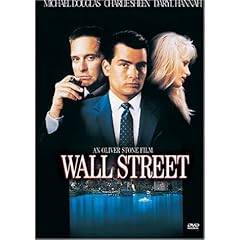 Just finished watching Wall Street, an Oliver Stone film, starring Charlie Sheen and Michael Douglas. It also has Martin Sheen (as Charlie's father) and Daryl Hannah.
Great movie. Top notch. It's from 1987, but I think it was way ahead of its time. I've been wanting to see it for a long time. Although it's all about Wall Street, the New York Stock Exchange, Money, Money, Money, it is a fascinating, microscopic, look at the rise of white collar crime in the 1980's.
I have seen a number of colleagues, and have interviewed with a number of "big-time" lawyers who fit the mold of Gordon Gecko (Michael Douglas) and Bud Fox (Charlie Sheen). Looking for that pie in the sky opportunity to stomp on somebody else, to take short-cuts and get to the top faster than the next guy. Willing to smudge the books to make themselves look better than the guy in the next office. How many times I have seen somebody pad their hours so that they might one day become partner, so that they might one day be able to look out the window of their cab, and feel justified in their smugness. And I haven't even been a member of the bar for very long.
 Bud: How much is enough? Gekko: It's not a question of enough, pal. It's a zero sum game, somebody wins, somebody loses. Money itself isn't lost or gained its simple transferred from one perception to another.
Hey, if that's you, have fun. It's not me. Some join the club to kiss their way to the top. But, some do it because they are looking towards the greater good. I like to think I am in the latter category. But, at the same time, it's not easy. I worked nearly 12 hours today. Why? Because I wanted to make more money? No. It was because I couldn't figure out how to close some bloody real estate files so that I could actually report to our client and actually transfer our fees from our trust account to our general account. That is reality for me today. But, I could leave work feeling good about myself, because I was trying my best to be honest and true to myself, and to my clients.
The best line of the film for me came from Bud's dad (Martin Sheen):
Carl Fox: Stop going for the easy buck and start producing something with your life. Create, instead of living off the buying and selling of others.
Amen to that. Amen to creating something great, something beautiful, something that belongs to me.
 Lou: The main thing about money, Bud, is that it makes you do things you don't want to do.
The film was also fascinating, given the garbage that is continuing today in Corporate America (and Canada) with the various corporate criminals being nabbed daily, and finally actually going to jail.
Enough rhetoric for tonight. I hope it sparks something in you, positive or negative. Feel free to comment.
Thursday, October 26, 2006
Law Schools: Links to all Canadian Law Schools
Need to do some surfing research on Canadian Law Schools? Here are all of the links:
University of Alberta Faculty of Law
University of British Columbia Faculty of Law
University of Calgary Faculty of Law
Dalhousie Law School
University of Manitoba Faculty of Law
Faculty of Law McGill University (Faculté de droit Université de McGill)
Faculté de droit de l'Université de Moncton
University of New Brunswick Law School
University of Ottawa Faculty of Law (Université d'Ottawa Faculté de droit)
Queen's University Faculty of Law
University of Saskatchewan College of Law
University of Toronto Faculty of Law
University of Victoria Faculty of Law
University of Western Ontario Faculty of Law
University of Windsor Faculty of Law
Osgoode Hall Law School, York University
University of Alberta Faculty of Law
University of British Columbia Faculty of Law
University of Calgary Faculty of Law
Dalhousie Law School
University of Manitoba Faculty of Law
Faculty of Law McGill University (Faculté de droit Université de McGill)
Faculté de droit de l'Université de Moncton
University of New Brunswick Law School
University of Ottawa Faculty of Law (Université d'Ottawa Faculté de droit)
Queen's University Faculty of Law
University of Saskatchewan College of Law
University of Toronto Faculty of Law
University of Victoria Faculty of Law
University of Western Ontario Faculty of Law
University of Windsor Faculty of Law
Osgoode Hall Law School, York University
Law School: Official Guide to Canadian Law Schools
If you want a great read about various stats on different law schools in Canada, visit the Official Guide to Canadian Law Schools, published on LSAC's website. It's really complete. I have never come across this resource before, so I am wondering how new it is. Good stuff!
Note that the next LSAT Dates and Deadlines are as follows:
Saturday, December 2, 2006 Monday, December 4, 2006*+ Saturday, February 10, 2007* Monday, February 12, 2007*+
* This test is NONDISCLOSED. Persons who take a nondisclosed test receive only their scores. They do not receive their test questions, answer key, or individual responses.
+ This test is for Saturday Sabbath observers only.
Visit LSAC.org for full information.
Also, check through the archives of this blog for LSAT information, help and links.
Note that the next LSAT Dates and Deadlines are as follows:
* This test is NONDISCLOSED. Persons who take a nondisclosed test receive only their scores. They do not receive their test questions, answer key, or individual responses.
+ This test is for Saturday Sabbath observers only.
Visit LSAC.org for full information.
Also, check through the archives of this blog for LSAT information, help and links.
Wednesday, October 18, 2006
Admissions: The Importance of where you do your undergrad degree
I had a call from a reader today who was considering transferring from her local, traditional university program to a long-distance learning program offerred through Athabasca University. Her question was whether such a move would be detrimental to her application success rate at various law schools. This is a good question, and I was glad to receive it.
From what I have heard, most, if not all law schools will not base your acceptance upon which university you have graduated from. However, I could be wrong about that. I would really appreciate any insight from any of you out there.
I can only really speak from personal experience. I completed my first degree at the University of Calgary. I wasn't satisfied with my GPA, and found my degree to be less than useful, so I enrolled at Athabasca University (Alberta) and completed a second degree in my true passion, English. My GPA was excellent, and seemed to serve very well in helping me to gain admittance at a number of law schools across Canada.
I have never heard of undergrad prejudice amongst admissions committees, but again, I could be proven wrong. I would love to hear any stories that would counter my experience.
From what I have heard, most, if not all law schools will not base your acceptance upon which university you have graduated from. However, I could be wrong about that. I would really appreciate any insight from any of you out there.
I can only really speak from personal experience. I completed my first degree at the University of Calgary. I wasn't satisfied with my GPA, and found my degree to be less than useful, so I enrolled at Athabasca University (Alberta) and completed a second degree in my true passion, English. My GPA was excellent, and seemed to serve very well in helping me to gain admittance at a number of law schools across Canada.
I have never heard of undergrad prejudice amongst admissions committees, but again, I could be proven wrong. I would love to hear any stories that would counter my experience.
Tuesday, October 17, 2006
Theft of a website
I noticed that sales of my book had gone down significantly this last week. I was really curious as to why, as sales are usually pretty steady. Demand for the book has increased over the last number of months. So, I started poking around, and realized that www.canadalawstudent.ca was no longer up. Some jerk snagged the URL. The URL had been registered to my old U of A email, and I guess they sent the notification that the URL was going to expire to that email. Well, I guess someone was lurking, because if you go to www.canadalawstudent.ca, you will now find somebody else's content. Boy, did that make me angry! I'm not linking to it in this post, because I don't want to support that jerk.
www.canadalawstudent.ca was built as a resource for current and prospective law students. It has been enjoyed by many, and is bookmarked by a lot of people.
As such, I will be reposting the content of that site to another URL within a few days. Please have patience with me. In the meantime, if you want the book, please click here. Sorry for the inconvenience. I wish that I could take that pirate down, but it would seem that he has now legally purchased the domain name, and we are all stuck scrambling to find another home on the WWW.
On another note, I promise to post some new material over the next week, so stay posted.
www.canadalawstudent.ca was built as a resource for current and prospective law students. It has been enjoyed by many, and is bookmarked by a lot of people.
As such, I will be reposting the content of that site to another URL within a few days. Please have patience with me. In the meantime, if you want the book, please click here. Sorry for the inconvenience. I wish that I could take that pirate down, but it would seem that he has now legally purchased the domain name, and we are all stuck scrambling to find another home on the WWW.
On another note, I promise to post some new material over the next week, so stay posted.
Thursday, September 14, 2006
A month of pure growth
It's been almost a month since I posted last, and I won't apologize. I've been busy! Starting up 3 law offices, straight out of my article year has been a challenge, let me tell you. A quick synopsis:
- I purchased a historical building in the small town where I live. I gutted it, renovated it, installed 4 offices, a reception area and a boardroom. I have rented out two of the offices to strategic tenants.
- We renovated a leased space in another city where we have our main office. We redid a bunch of walls, the carpets, doors, paint, etc.
- I put together endless pieces of furniture! I still have many blisters on my hands from the stupid screwdrivers.
- I built, along with a designer, our new website www.lelaw.ca.
- I held a grand opening
- I have been working my *** off, as file after file has been coming in the office located in my town of residence. I am amazed by the instant success of this endeavor, but not so surprised as I should be. Alberta is a booming economy, and the $ have trickled into my town. Real estate is fantastic. I also ran a "will special" for the last month, and have been inundated, both with requests for wills, but lots of referral work as a result of will clients.
- We are in the process of purchasing another building in the other town where we have an office, renovating it and making it rock!
- We are in the process of getting the proper staff in our offices (this has proven to be a great challenge, and a real balancing act - I have spent way too much time doing adminstrative work, when I could be concentrating on business development).
Thursday, August 24, 2006
Articling: Watching your Classmates Succeed
I didn't really think about it much during law school, but now that it is here, I really enjoy watching my friends and classmates going through their bar call ceremonies and becoming members of the Law Society. I haven't been able to attend all of the ceremonies, but I have been able to see photos and have heard the stories. Thinking back to their scared faces in those first year classes, and thinking of all of the panic going on in the law library, I wonder if I looked equally scared and panicked. All of my friends, save one or two, have succeeded in obtaining articles, completing their articles and bar exam/CPLED requirements, and getting offers from their firms. That's pretty good, I think. Way to go guys and gals!
The bar call ceremony is different everywhere. In Calgary and Edmonton, for example, you often do the ceremony en masse with a bunch of other new lawyers. In smaller centres, you usually go alone, or with one other person. That was the case for me. I went with another fellow who had been a solicitor in the U.K. for 11 years.
Our judge, a member of the Court of Queens Bench, met with us before hand, interviewed us, shared some good inside jokes and shared a bit of sage advice. The ceremony itself was really nice. Although it had its formal moments, it was also filled with joviality, and even laughter. It was really great to have friends and family in attendance. I have some classmates who had family come from pretty far away. For many parents, it is a very proud moment.
You will have to wear robes to your bar call ceremony in most jurisdictions. Some jurisdictions (such as Saskatchewan, I believe), you just go down somewhere and sign the Law Society register. There is no real ceremony. If you do end up having to wear robes, be prepared to pay between $900 and $1000. Some firms will cover this cost. You may want to negotiate this with your firm when you negotiate your articling contract. I didn't realize they would be so much money, and it hurt my bank account at a time when I was hoping to start getting ahead on student loans.
There are a bunch of administrative hoops that you will need to go through before you get called to the bar. In Alberta, the rule is that you cannot be called to the bar until 30 days have passed beyond the end of your articles. That is also something that nobody told me about before beginning my article, or during my article. What a rip off! Another month at articling salary sucks. I was able to push my call date up one week, but apparently that is as far as it can be pushed. So, be prepared for this little technicality. You will also have to fill out a bunch of paperwork, which will include your principal. Get this done before the end of your articles, so that you can submit it the day after your articles are complete and shorten any possible delays.
Be sure to read through the archives of this blog. There are many entries about law school, articling, the LSAT, and more. Shoot me any questions you might have, and be sure to check out my book whether you are just thinking about law school, are about to write the LSAT, are applying for law school, in law school already, or about to apply for articles.
The bar call ceremony is different everywhere. In Calgary and Edmonton, for example, you often do the ceremony en masse with a bunch of other new lawyers. In smaller centres, you usually go alone, or with one other person. That was the case for me. I went with another fellow who had been a solicitor in the U.K. for 11 years.
Our judge, a member of the Court of Queens Bench, met with us before hand, interviewed us, shared some good inside jokes and shared a bit of sage advice. The ceremony itself was really nice. Although it had its formal moments, it was also filled with joviality, and even laughter. It was really great to have friends and family in attendance. I have some classmates who had family come from pretty far away. For many parents, it is a very proud moment.
You will have to wear robes to your bar call ceremony in most jurisdictions. Some jurisdictions (such as Saskatchewan, I believe), you just go down somewhere and sign the Law Society register. There is no real ceremony. If you do end up having to wear robes, be prepared to pay between $900 and $1000. Some firms will cover this cost. You may want to negotiate this with your firm when you negotiate your articling contract. I didn't realize they would be so much money, and it hurt my bank account at a time when I was hoping to start getting ahead on student loans.
There are a bunch of administrative hoops that you will need to go through before you get called to the bar. In Alberta, the rule is that you cannot be called to the bar until 30 days have passed beyond the end of your articles. That is also something that nobody told me about before beginning my article, or during my article. What a rip off! Another month at articling salary sucks. I was able to push my call date up one week, but apparently that is as far as it can be pushed. So, be prepared for this little technicality. You will also have to fill out a bunch of paperwork, which will include your principal. Get this done before the end of your articles, so that you can submit it the day after your articles are complete and shorten any possible delays.
Be sure to read through the archives of this blog. There are many entries about law school, articling, the LSAT, and more. Shoot me any questions you might have, and be sure to check out my book whether you are just thinking about law school, are about to write the LSAT, are applying for law school, in law school already, or about to apply for articles.
Monday, August 07, 2006
Law School - Get a Real Mentor
Some schools offer formal mentorship programs for first year law students. This may link up professors and law students, practitioners and law students, or even lower-year and upper-year law students. My experience with this was abysmal. It may have been fantastic for other classmates or colleagues at other law schools, but for me it was useless. The practitioner that I was assigned to was extremely overworked, overstressed and overcome with emotion about his own career. He signed up for the mentorship program with very good intentions, I am sure, but bit off much more than he could chew. As a result, the time that I was able to squeeze out of him was comparatively futile for both of us. Scheduled appointments were postponed, invitations to attend court cancelled, and the relationship quickly deteriorated and eventually disappeared by my second semester of law school. I have heard similar stories from classmates.
I would highly suggest seeking out a formal mentor of your own choice and finding. A practitioner is great, if you can find one. A family friend or colleague of someone that you know is ideal, as they will feel more inclined to make good on their commitment that they make to you, and may feel more accountable for the relationship. Seek out someone who you perceive to handle stress well, to be on top of their game, and most importantly, who shares some of your interests, both in and out of law school. Try to strike up a professional relationship, but do not be afraid to be friendly.
In my experience, a golf game or coffee with a chosen mentor is worth more than almost anything in law school. A small word of advice from a veteran of the law school and practical legal worlds can save you tons of time and stress, and can really help you in your goals to succeed. A good mentor can also be invaluable when it comes time to apply for a summer job or an article. A practitioner can be an excellent ‘in’ at the law firm that they work for, but also at other firms. Remember, they were once law students, and likely have maintained friendships with their past classmates or co-workers. The legal community is relatively small, and having an ally, or more than one ally, can be like gold when it comes to obtaining employment in your field of choice.
I would highly suggest seeking out a formal mentor of your own choice and finding. A practitioner is great, if you can find one. A family friend or colleague of someone that you know is ideal, as they will feel more inclined to make good on their commitment that they make to you, and may feel more accountable for the relationship. Seek out someone who you perceive to handle stress well, to be on top of their game, and most importantly, who shares some of your interests, both in and out of law school. Try to strike up a professional relationship, but do not be afraid to be friendly.
In my experience, a golf game or coffee with a chosen mentor is worth more than almost anything in law school. A small word of advice from a veteran of the law school and practical legal worlds can save you tons of time and stress, and can really help you in your goals to succeed. A good mentor can also be invaluable when it comes time to apply for a summer job or an article. A practitioner can be an excellent ‘in’ at the law firm that they work for, but also at other firms. Remember, they were once law students, and likely have maintained friendships with their past classmates or co-workers. The legal community is relatively small, and having an ally, or more than one ally, can be like gold when it comes to obtaining employment in your field of choice.
Wednesday, August 02, 2006
Still Birthing the law firm
I apologize for not posting regularly as of late. I have been up to my neck in setting up our new law offices. It's been two months of exhileration and fun. Business is going good, and our offices are 95% complete. I promise to post more during August, so stay tuned.
In the meantime, check out this cool story about a former lawyer from Quebec gone music industry. As I keep saying, a law degree can lead to so many possibilities.
In the meantime, check out this cool story about a former lawyer from Quebec gone music industry. As I keep saying, a law degree can lead to so many possibilities.
Subscribe to:
Posts (Atom)